

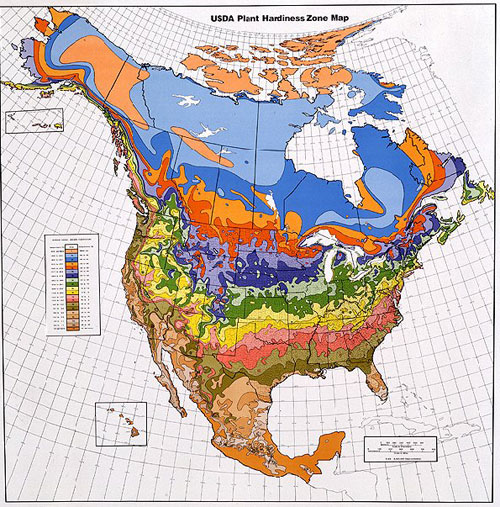
When selecting plantings for you backyard habitat, it’s important that you know about planting zones. Planting zones refer to USDA Hardiness Zones, and are based on estimates of the lowest range of temperatures that occur within a particular area. They are the result of many years of data collected and shared by the U.S. Department of Agriculture, the U.S. National Arboretum and the American Horticultural Society, and are used to determine where any given tree, shrub, vine, groundcover or flower will grow and thrive in the United States. These zones have numbers assigned to them; the lower the number, the colder the zone, and vice versa.
If you look at a map of the zones, you will see that in some areas one zone prevails, but there are pockets of the zone above or below it. For instance, zone 5 has pockets of zone 6, and zone 6 has pockets of zone 5. Zone 5’s lowest temperature is minus 20 degrees to minus 10 degrees, while zone 6’s is minus10 degrees to 0 degrees. While this may not seem like a big difference to you, it is to the plants, and can mean the difference between survival and failure. So, it’s important to be sure that the zone the plant is suited for is the zone your property is in.
When you visit a nursery, you will usually find plants suitable for your property, since they tend to provide only those plants that will grow in the surrounding area. You’ll also find that plants usually have a tag that gives you their soil, sun, and water requirements. If not, the staff should be able to give you the advice you need.
Only one
Sometimes, you will find that plants have only one zone listed, say, zone 4. This means that the plant is hardy – meaning it will survive – in all zones higher in number and warmer than zone 4, but it is not suited to the zones with lower numbers, which are colder. It is especially important you know what this means when you are ordering by mail, or selecting plants from books. As a general rule, it’s usually better to select plants that do well in the zone one number lower than the one you live in, so that you don’t loose it to a harsher than average winter. That means that if you live in zone 7, a plant that will grow in zone 6 will have a better chance at survival.
Microclimates
Microclimates should also be taken into consideration, as they can exist within feet of one climate zone but be several critical degrees higher or lower than the surrounding area. One example of a microclimate could be a stone patio, where the heat absorbed by the stones raises the temperature of the surrounding area, especially if it is also in a southern location; such a location would allow tender annuals to grow better and longer in a area of the country with a short, cool summer by taking advantage the of the heat reflected from the stones. Another example could be a garden surrounded by a high, dense hedge which serves as a windbreak and shades the soil, thereby slowing the rate of water evaporation. On a larger scale, a mountain top with no natural windbreak will be much colder and windier than the valley below it, which will be warmer and less prone to moisture loss from the wind. Although microclimates sound complicated, they really aren’t. It’s just a matter of taking into consideration all the elements inherent to any given piece of property.
It’s also a good idea to contact your local Cooperative Extension to see which plantings are well suited your area, which will include lists of natives. Keep in mind that plants that are native to your area will need fewer chemicals like fertilizers, are less susceptible to insect damage and disease, and require less water. Natives are also programmed to flower and fruit at the same time that local species of birds need them for nectar and food. And, birds that nest in native species have greater success at surviving predation.
Visit the United States National Arboretum Web site for a hyper-linked version of this map with links to more detailed views by state.
Visit the Home Gardening section of the USDA Web site for excellent home gardening information on a variety of topics.
| Zone | Fahrenheit | Celsius | Example Cities |
|---|---|---|---|
| Fairbanks, Alaska; Resolute, Northwest Territories (Canada) | |||
| Prudhoe Bay, Alaska; Flin Flon, Manitoba (Canada) | |||
| Unalakleet, Alaska; Pinecreek, Minnesota | |||
| International Falls, Minnesota; St. Michael, Alaska | |||
| Tomahawk, Wisconsin; Sidney, Montana | |||
| Minneapolis/St.Paul, Minnesota; Lewistown, Montana | |||
| Northwood, Iowa; Nebraska | |||
| Des Moines, Iowa; Illinois | |||
| Columbia, Missouri; Mansfield, Pennsylvania | |||
| St. Louis, Missouri; Lebanon, Pennsylvania | |||
| McMinnville, Tennessee; Branson, Missouri | |||
| Oklahoma City, Oklahoma; South Boston, Virginia | |||
| Little Rock, Arkansas; Griffin, Georgia | |||
| Tifton, Georgia; Dallas, Texas | |||
| Austin, Texas; Gainesville, Florida | |||
| Houston, Texas; St. Augustine, Florida | |||
| Brownsville, Texas; Fort Pierce, Florida | |||
| Naples, Florida; Victorville, California | |||
| Miami, Florida; Coral Gables, Florida | |||
| Honolulu, Hawaii; Mazatlan, Mexico |