
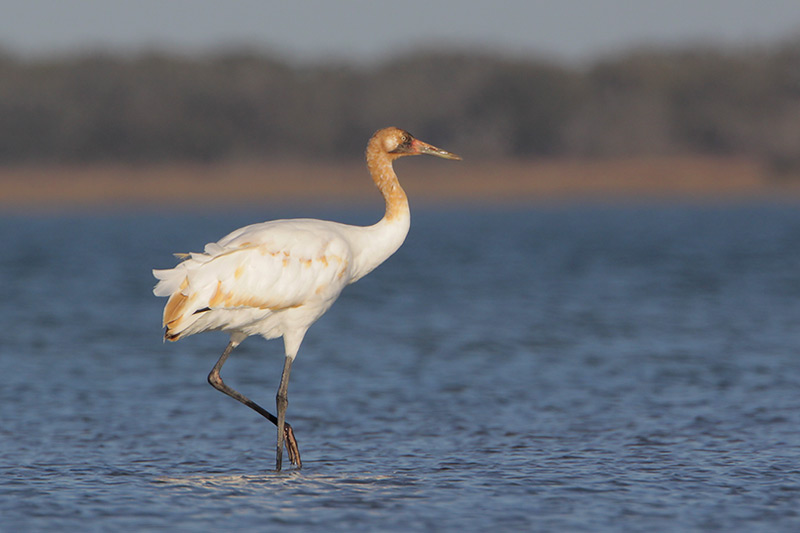

The Whooping Crane (Grus americana) is the tallest bird in North America with striking white plumage.
It was once on the brink of extinction, with only 21 individuals left in the wild in 1941. Through dedicated conservation efforts, the population has slowly grown, and there are now over 600 individuals in the wild.
However, the species is still considered endangered, with threats including habitat loss, collisions with power lines, and climate change.
Adult
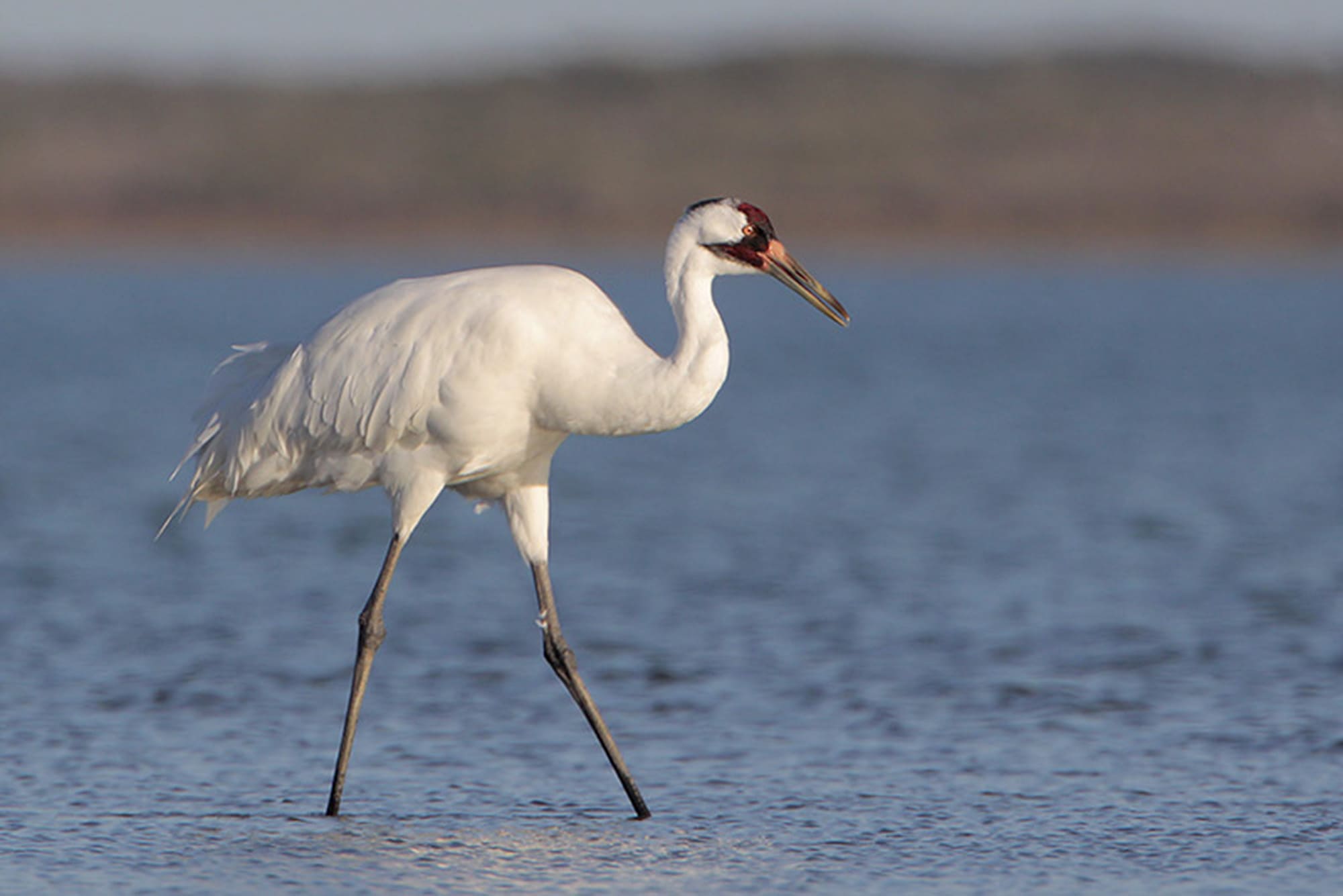
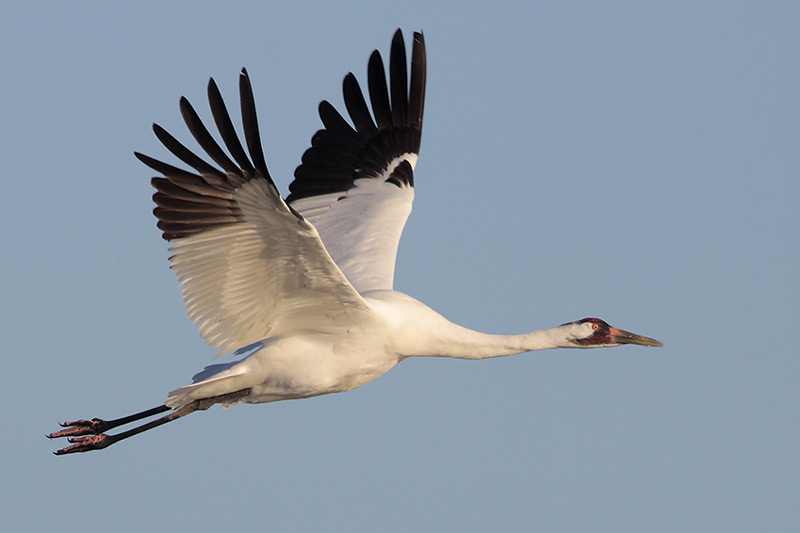
Adult Whooping Cranes are large and tall birds with almost all-white plumage. The only exceptions are the black primaries on their wings, red crest, and black accents on its head. The black primaries are only visible when they’re flying. They have long black legs, grayish-pink toes, a long neck, and a long and dark pointed bill.
Male and female Whooping Cranes are similar in appearance, although males are about two pounds heavier on average. They can grow up to 4-5 feet high and 4 feet 4 inches long.
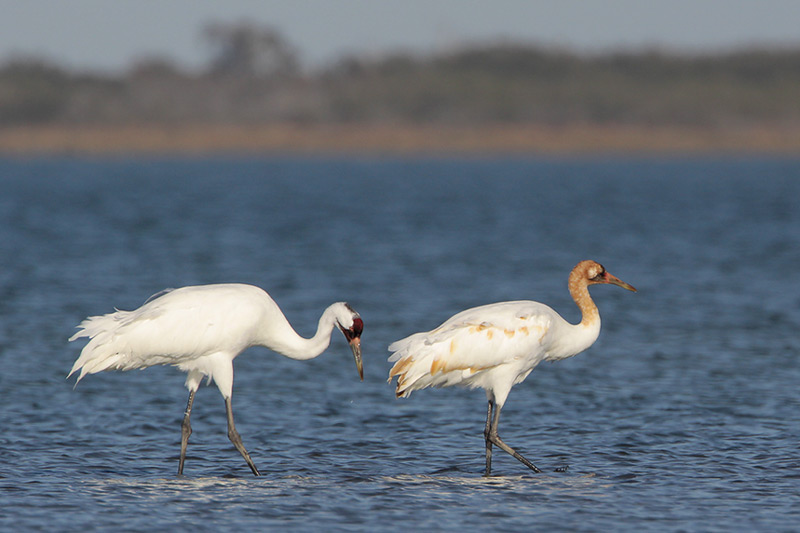
An adult and a juvenile Whooping Crane
Juvenile
Whooping Cranes lay 1-3 light brown or olive eggs with brown splotches that take 29-31 days to hatch.
Their chicks are cinnamon brown and leave the nest within a couple of hours after hatching. Both parents feed the offspring until they reach independence, which occurs at around 9 months of age.
As they get older, juvenile Whooping Cranes develop white plumage but it is blotched with light cinnamon tones.
Habitat
Whooping Crane habitats are primarily marshy areas, shallow and grassy wetlands, mudflats, and wet prairies. They prefer to nest in marshes on a raised area that is surrounded by water and camouflaging vegetation.
The pair forms the nest on the ground by piling and stomping down surrounding vegetation, such as sedges and cattails. The nest is a big platform, measuring 2-5 feet across, with a shallow depression in the middle.
Diet
Whooping Cranes are omnivores who eat whatever’s available, although they prefer animal matter above plant matter. Their diet includes small mammals, fish, reptiles, amphibians, mollusks, insects, aquatic crustaceans, roots, seeds, grains, nuts, and fruit.
Specific diet depends on their location and season. Their winter and summer diets are probably quite similar. It includes insects, crustaceans, frogs, snakes, mice, voles, snails, small fish, seeds, roots, and berries. Migrating Whooping Cranes lean heavily on waste grain, such as barley, wheat, and corn.
You can see them foraging by wading in shallow water or walking through fields, sometimes probing something with their bills. They search for insects, berries, and other stuff in low vegetation, snatch prey from the ground, and poke around in the wet soil. They may use their bill to stab larger prey.
Behavior
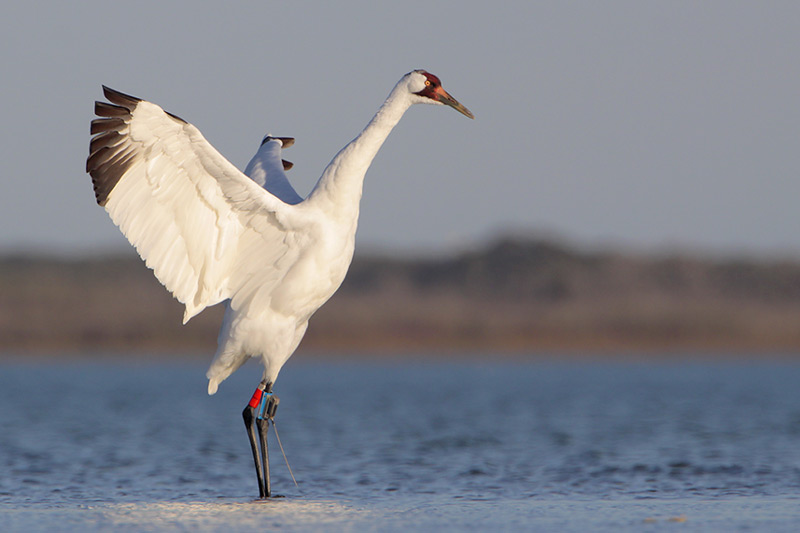
Whooping Cranes are monogamous and generally mate for life. They perform elaborate displays where they leap, toss their heads, flap their wings, give bugling calls, throw grass and feathers, and somehow still manage to look dignified.
Whooping Crane
The breeding pairs have a territory and will attack intruders by flapping, stabbing, jumping, slashing, or releasing threatening hisses, which throws off most of the attackers. They are rather solitary, living alone, in pairs, or very small flocks or families.
Whooping Cranes are active during the day and sleep on the ground at night.
Range (and seasonal changes)
Once upon a time, Whooping Cranes ranged throughout midwestern North America to north-central Mexico and were fairly common. In the 1940s and 1950s, however, their population declined, and the species almost went extinct due to over-hunting, human disturbance, and habitat loss. Now their range is quite small and they’re listed as an endangered species on the IUCN Red List.
Related: Endangered birds – how can we help them?
There are two migrating populations. One breeds in Canada within the Wood Buffalo National Park and the other in Wisconsin.
The former migrates to Texas for the winter and the latter migrates to Florida with the help of ultralight aircraft. The other two populations are reintroduced and nonmigratory and reside in Florida and Louisiana.
Thanks to strict conservation efforts, the population of Whooping Cranes is increasing and is currently at about 600 individuals.
Wing shape
Whooping Cranes have broad and long wings suited for flying long distances. The bird has an astonishing wingspan of 7-7.5 feet and flies with slow and steady wingbeats.
They make use of strong gusts of wind which help them conserve energy. The black primaries are visible while the bird flies. It keeps its long neck and legs fully extended.
Fun Facts
- Whooping Cranes are the rarest cranes in the world. The only self-sustaining and naturally occurring flock is the one that breeds in Canada and winters in Texas. All the Whooping Cranes alive today are descendants of that flock.
- Whooping Crane is the tallest North American bird species.
- Whooping Cranes got their name from the loud sound that they make. In good conditions, its voice can carry over distances of up to 5 miles. The scientific name of their genus also refers back to their call. The word Grus comes from Latin and means “to cry hoarsely.”
- Whooping Cranes have a long life expectancy and may live to be 22-24 years old in the wild. The oldest wild Whooping Crane lived to be 28 years and 4 months old. In captivity, these birds can live up to 40 years old.
- Cranes symbolize grace, faithfulness, travel, immortality, and longevity. They’re often considered mystical and good luck.
Vocalization
Whooping Cranes have developed many different calls for communicating, which are mostly some kind of variations of their bugle call.
They have calls for keeping in contact, when they’re stressed or in distress, when begging for food, giving an alarm, flying, guarding, giving location, or nesting. They also hiss at intruders.
Similar Species
Whooping Cranes can be mistaken for some other bird species. Here are the most common options.
Great Egret
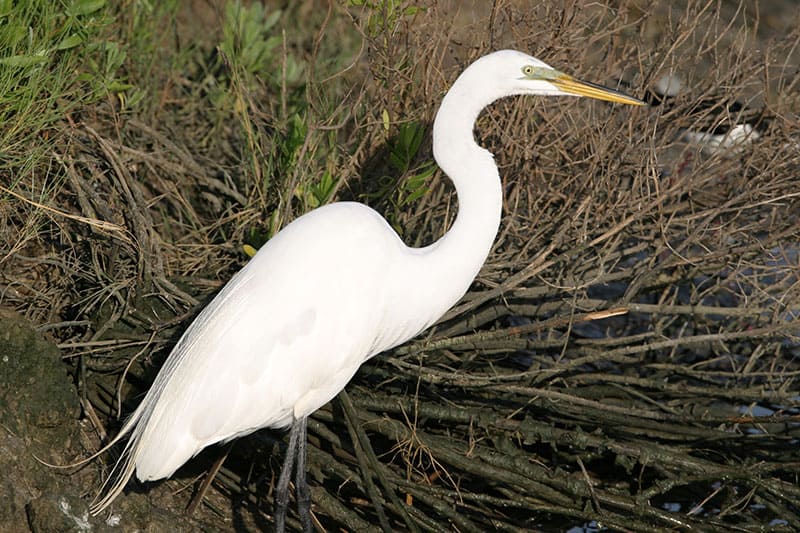
Even though egrets and cranes are two different species, they still share some similarities.
Both Whooping Cranes and Great Egrets are primarily white, but Whooping Cranes have bars on their wings.
Great Egrets have yellow bills and don’t have any markings on their heads. They have longer necks that curve in an S-shape, which they fold when flying.
Sandhill Crane
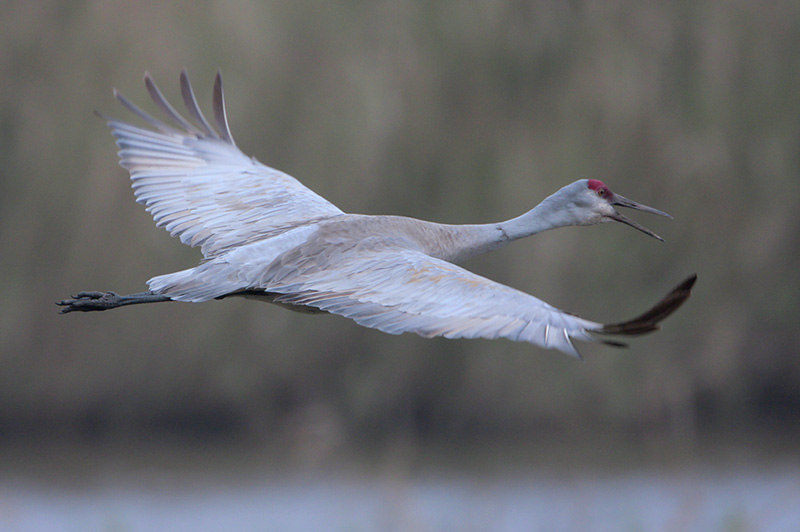
In flight, Sandhill Cranes look similar to Whooping Cranes.
Sandhill Cranes have grayish plumage, but their underside looks white.
Whooping Cranes have black near their wingtips, but Sandhill Cranes tend to have a darker line across the edges of their wings.
Frequently Asked Questions
Is it rare to see a Whooping Crane?
Whooping Cranes are the rarest crane species in the world, and it is very rare to see one out in the wild. Only 600 wild individuals remain in the wild.
How many Whooping Cranes are left in the United States?
Around 600 Whooping Cranes are left in the United States, all of them descending from the small flock that breeds in Canada and winters in Texas.
What is the difference between a Whooping Crane and a Sandhill Crane?
Whooping Cranes are almost all-white, whereas Sandhill Cranes are slate gray. In flight, Sandhill Cranes appear whitish underneath and lack the black wingtips a Whooping Crane has.
