
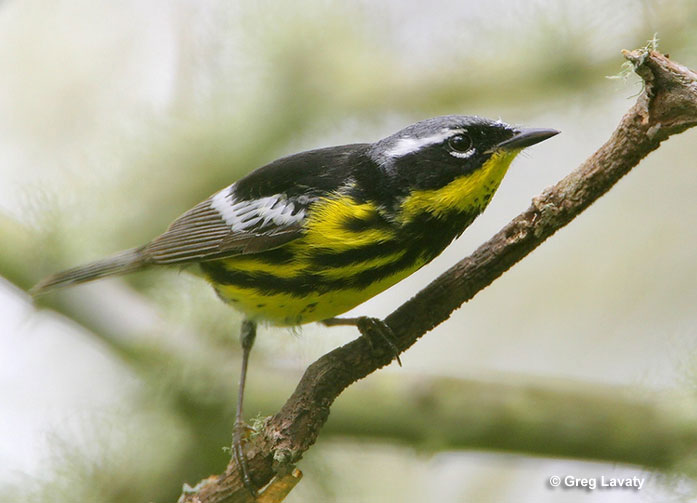

Magnolia Warblers (Setophaga magnolia) are small, brightly colored songbirds that are known for their distinctive songs and lively behavior.
These migratory birds are a common sight in North America during the spring and fall, when they pass through on their way to and from their breeding grounds in the boreal forests of Canada.
The males are particularly striking, with their bold black and yellow plumage. There are quite a few similar species, so read on to discover what makes them unique!
Breeding Male
Male Magnolia Warblers sport a combination of black, yellow, gray, and white feathers. They have a black mask and back, gray cap, white eyebrows, and yellow undersides with distinctive black streaking and a black “necklace”.
Their short and small bill is black, their black wings have a white patch on their wings and their tail has a white base and black tip.
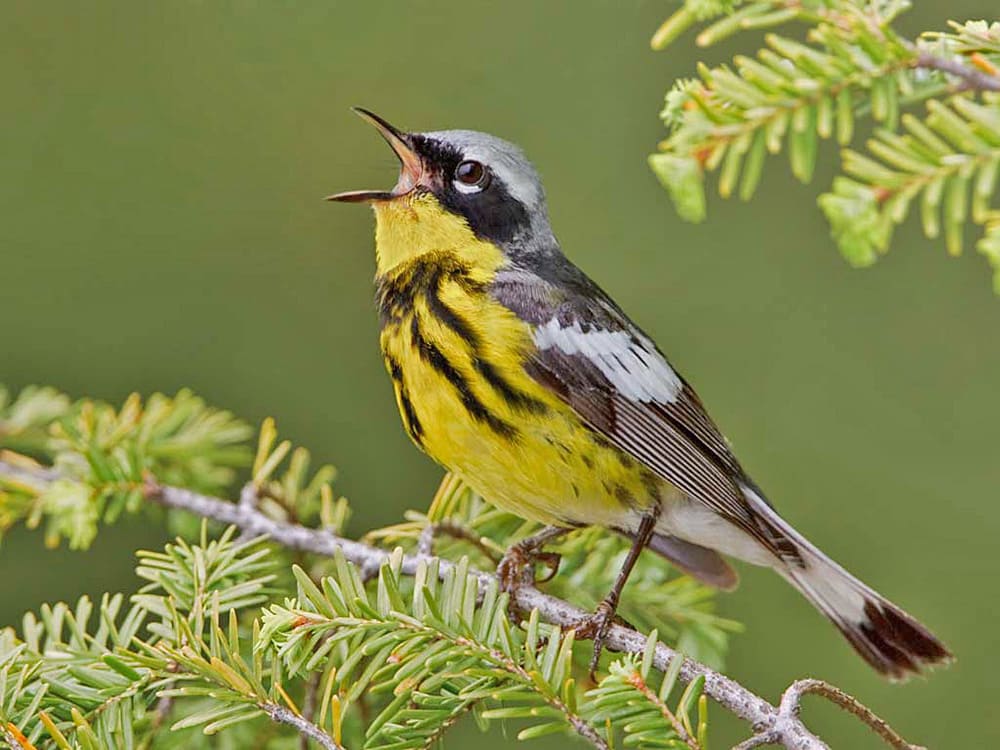
Photograph © Glenn Bartley.
Female
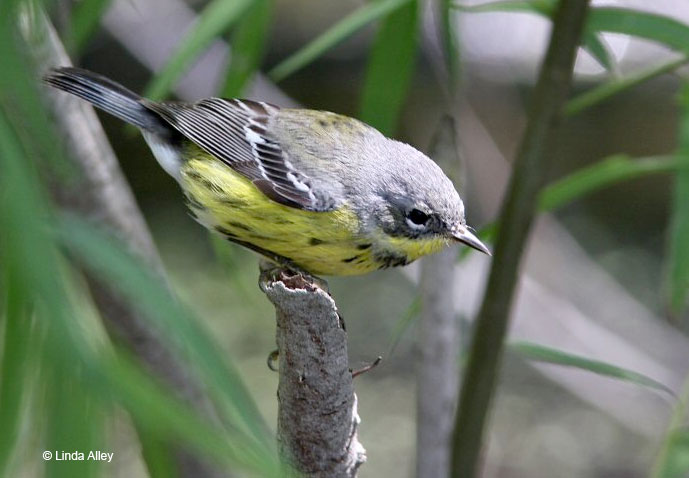
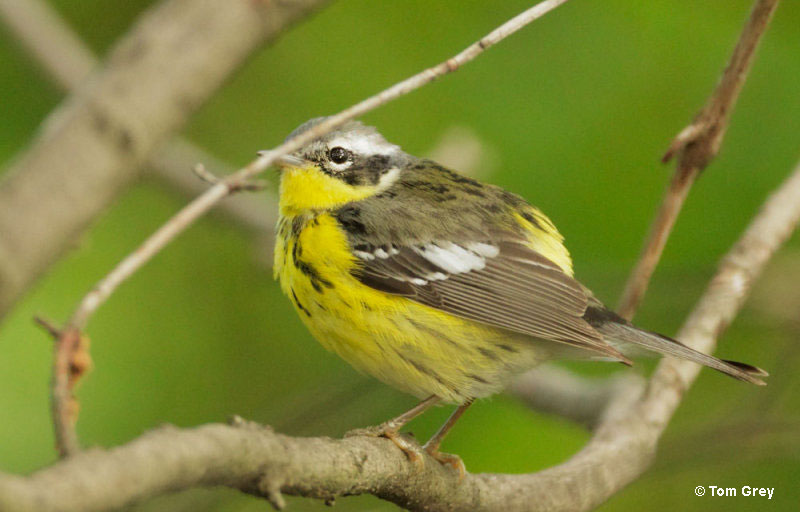
Female Magnolia Warblers are a bit more modest and paler. They have a gray upper back and cap, grayish-yellow back, yellow undersides with faint black streaking on flanks and chest, and two narrow white wingbars on their black wings. They lack the black mask the male has.
Juvenile
Magnolia Warblers may have 1-2 broods per year with 3-5, usually four eggs in a clutch. The eggs are white to creamy white and speckled with various darker colors and are under an inch wide and long.
Incubation takes about 11-13 days, and the young leave the nest after 8-10 days. Parents take care of them for up to three or four more weeks.
Juvenile Magnolia Warblers look similar to females. They are paler in color, may have white rings around their eyes, and have more gray and some brown and olive coloring as well.
Magnolia Warblers are small birds that grow to be 4.3-5.1 inches long and weigh around 0.2-0.5 ounces.
Habitat
Magnolia Warblers inhabit dense and damp coniferous forests with trees like spruce, pine, balsam firs, and hemlocks. They prefer to go about their day in the lower parts of the tree. Their preferred breeding ground has dense young spruce, pines, and hemlocks. During migration, you may see it in deciduous shrubs, dense vegetation at forest edges, and low trees.
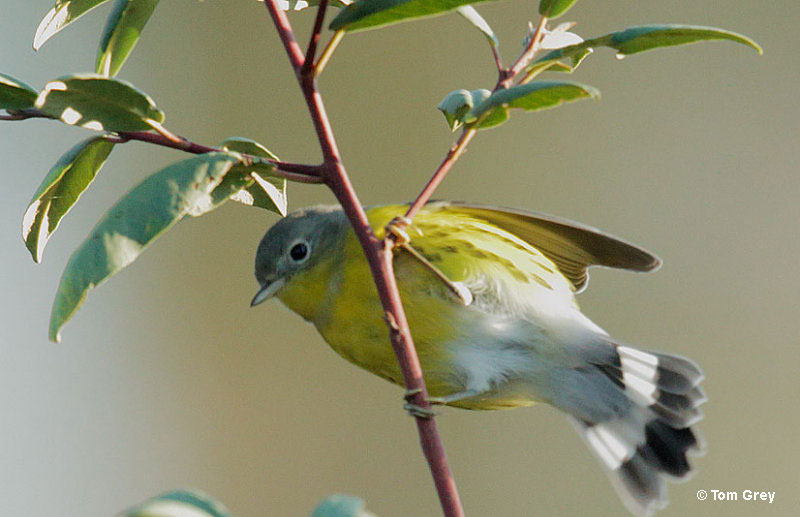
Magnolia Warblers nest low, usually less than 10 feet off the ground, in dense conifers, including hemlock, spruce, and balsam fir. The pair builds the flimsy nest on a horizontal branch close to the trunk of the tree.
It is made of grasses, twigs, and weeds and lined with hairs and fungus. The female does most of the building whereas the male helps to gather materials.
© Tom Grey
Diet
Magnolia Warblers are carnivores. Their favorite food is insects, such as moth caterpillars, spiders, worms, flies, lice, leafhoppers, beetles, and aphids. When the weather is bad and insects aren’t readily available, they may resort to snacking on fruit or berries.
They forage by hopping along the lower and outer branches of trees, mostly conifers, gleaning insects from the underside of needles, leaves, bark, and branches.
You may also see it hovering or darting out to catch flying insects. Males tend to forage higher, whereas females lower.
Behavior
Magnolia Warblers are solitary and are most often seen by themselves or with a mate. Despite that, they’re generally not hostile toward other warblers and birds, unless they’re protecting their nest. You may see them join foraging flocks of other birds during migration and winter.
These birds are active during the day. Males like to sing at dawn and dusk. When they’re courting females, they spread their tails in a display, showcasing their white spots.
This is also done when trying to intimidate intruders. The pair shares a territory on breeding grounds but separate for the winter.
Range (and seasonal changes)
Magnolia Warblers range throughout North and Central America. They’re long-distance migrants. Their breeding grounds cover central and southern Canada, extending into the northeastern United States.
They migrate to Central America as far as Panama for the winter. You can see them in the eastern half of the United States during migration.
Magnolia Warblers are listed as a species of least concern on the IUCN Red List. Their population is increasing even though they’re vulnerable to loss of habitat since many coniferous forests are in a decline.
Wing shape
Magnolia Warblers have a wingspan of 6.3-7.9 inches. Their wings are short and broad, perfect for maneuvering in dense forests.
The shape of their wings helps them to accelerate and take off quickly and maneuver well at low speeds.
Fun Facts
- Contrary to its name, Magnolia Warblers aren’t usually seen in magnolias. The species got its name because the ornithologist that discovered them first saw the birds in magnolias.
- Magnolia Warblers migrate at night. When flying south to their wintering grounds, they generally take a more eastern route, whereas when they’re returning in the spring, they tend to take a more central route.
- Magnolia Warblers may hybridize with other warblers, such as the Yellow-rumped Warbler and the American Redstart.
- The average lifespan of a Magnolia Warbler hasn’t been determined. The oldest known and recorded individual was an 8-year-old female.
Call
The male Magnolia Warblers sing two types of songs: a short 1-second song with alternating higher and lower pitches, followed by a loud and emphatic final note, and a second type of song without the final note, which they sing at dawn and dusk.
However, the female warblers do not have distinct songs for different situations, but they do sing and have short call notes, such as a nasal zeep or zic to signal the presence of a human observer or threatening predators.
Both male and female warblers use their call notes for various alerts, while the males use their songs for courtship and territorial marking during the spring migration and breeding seasons.
Similar Species
Some species are quite similar to the Magnolia Warbler, but worry not; you can distinguish them upon looking closer.
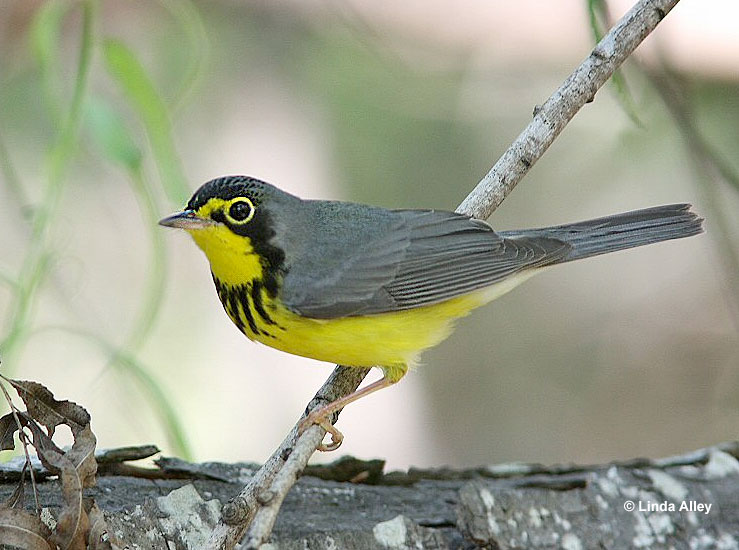
Canada Warbler
Canada Warbler
Magnolia Warblers look the most similar to Canada Warblers. The two have roughly the same range, so it can sometimes get tricky.
The easiest way to identify one or the other is to make sure if the bird has any white patches on its head and wings. Canada Warbler doesn’t have any white patches, but both have some white underneath their tails.
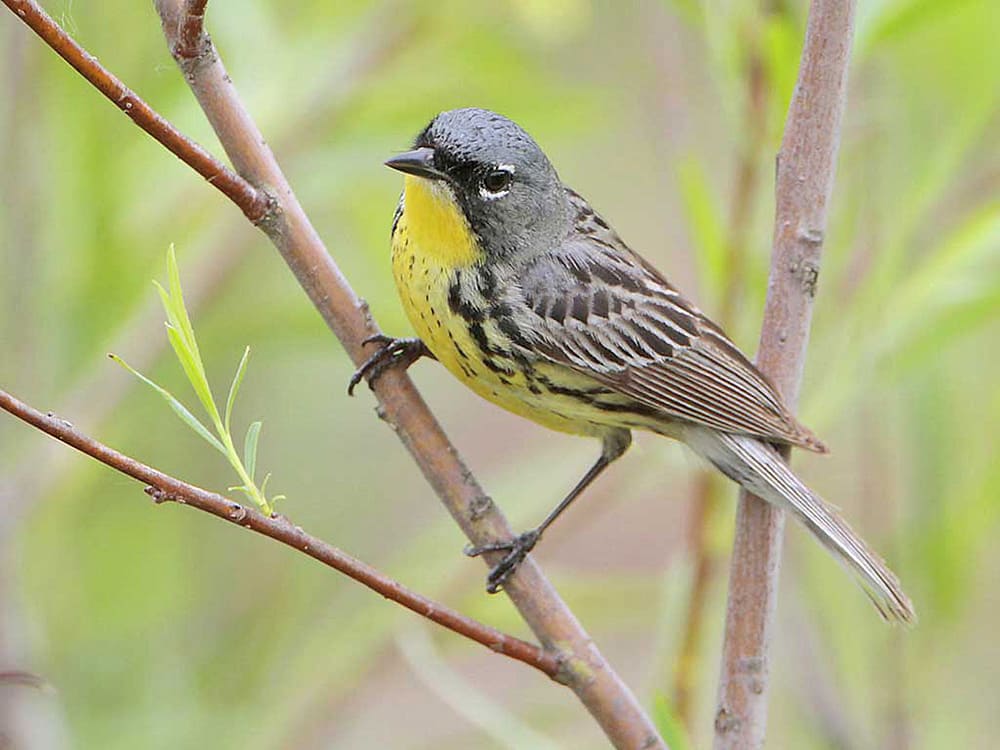
Kirtland’s Warbler
Kirtland’s Warbler
Although Kirtland’s Warblers look pretty similar to Magnolia Warblers, they are much more gray in their plumage.
Additionally, Magnolia Warblers have stripes running down their necks, while Kirtland’s Warblers have constant yellow on their chests.
Similarly to Canada Warblers, Kirtland’s Warblers lack white patches.
Frequently Asked Questions
Are Magnolia Warblers rare?
Magnolia Warblers are common within their range. However, in most of the United States, they’re only seen during migration.
Where does the Magnolia Warbler live?
In North America, Magnolia Warblers live in dense coniferous forests whereas in Central America they inhabit tropical forests and plantations.
Does the Magnolia Warbler migrate?
Magnolia Warblers are migratory and migrate between their wintering grounds in Central America and breeding grounds in Canada.
