
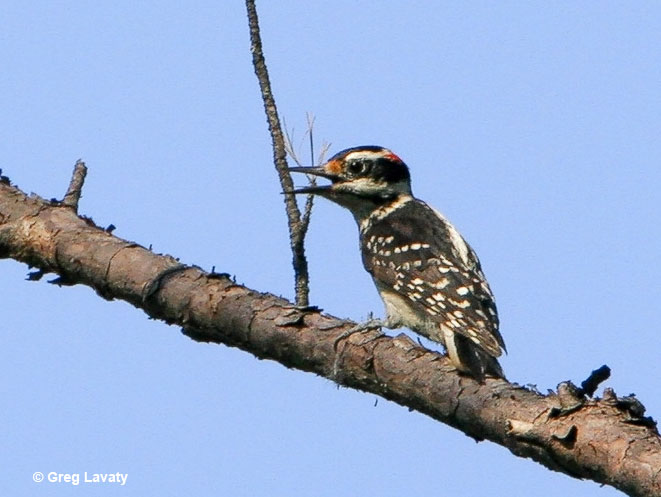

The Hairy Woodpecker is a medium-sized woodpecker with long, stiff tail feathers that allow them to lean against tree trunks, long, straight bills, and relatively square heads. Their bills are almost the same length as their head.
You can find Hairy Woodpeckers by looking at the main branches and trunks of large trees. You can also listen for their explosive peek call or sharp whinny to help find them.
Identification
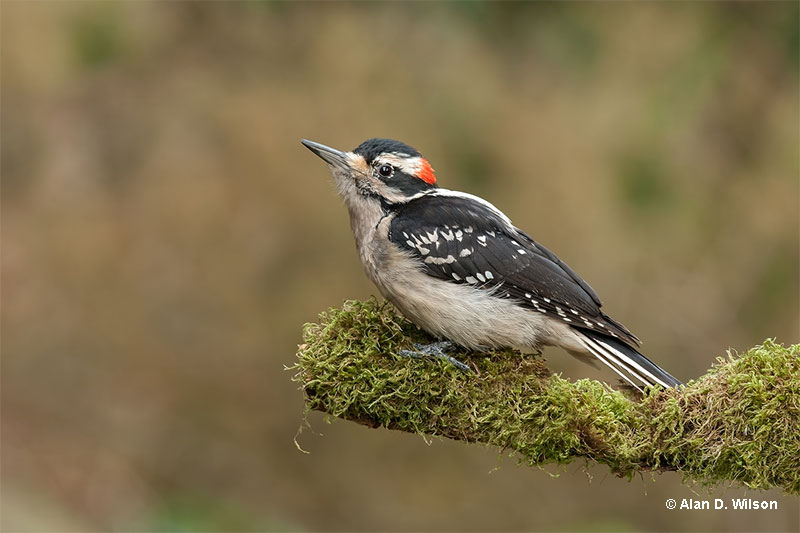
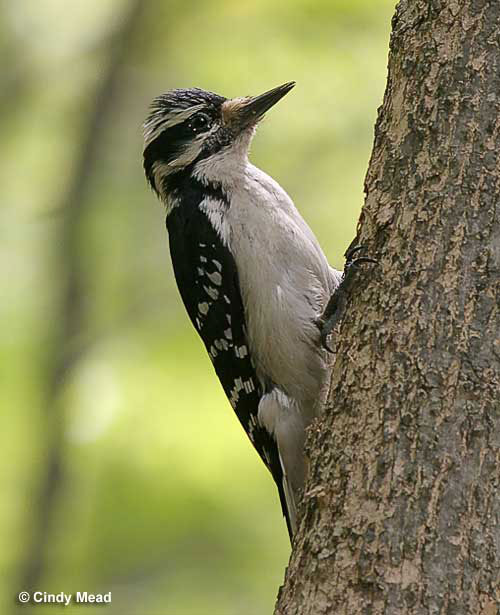
Hairy Woodpeckers have black-and-white and boldly patterned plumage. The head has two white stripes and a patch of red on the back. The black wings are checkered with white. Their black backs have a big white patch that runs down the center. These birds are 7.1 to 10.2 inches long, weigh 1.4 to 3.4 ounces, and have a wingspan of 13 to 16 inches.
© Alan D. Wilson
Female Hairy Woodpeckers look identical to breeding male Hairy Woodpeckers (except for the red patch). They’re the same size and length and have the same wingspan as breeding males. They also weigh the same amount.
Hairy Woodpecker plumage varies significantly over their wide range. Birds that live in the northern areas tend to be larger than birds that live in the southern areas. Hairy Woodpeckers that inhabit areas east of the Rockies are white below with spotted wings, while birds that inhabit areas west of the Rockies have narrower facial stripes and less spotting.
Birds in the Pacific Northwest are black and brown instead of black and white.
Food
Hairy Woodpeckers primarily consume insects, specifically the larvae of bark beetles, wood-boring beetles, moth pupae in their cocoons, and ants.
In addition, they’ll sometimes consume wasps, bees, caterpillars, millipedes, spiders, cockroaches, grasshoppers, and crickets. Bark beetles are known to sometimes cause extensive infestations in a large number of live trees. During times like this, their populations can go into the billions.
When these infestations occur, Hairy Woodpeckers will appear in large numbers to eat the bark beetle larvae. A similar pattern occurs in recently burned forests. Hairy Woodpeckers have also helped control outbreaks such as codling moths in orchards.
Nesting and Eggs
Hairy Woodpeckers usually excavate their nests in dead trees or the dead stub of a living tree. Most of the time, whatever tree they do choose has heart rot.
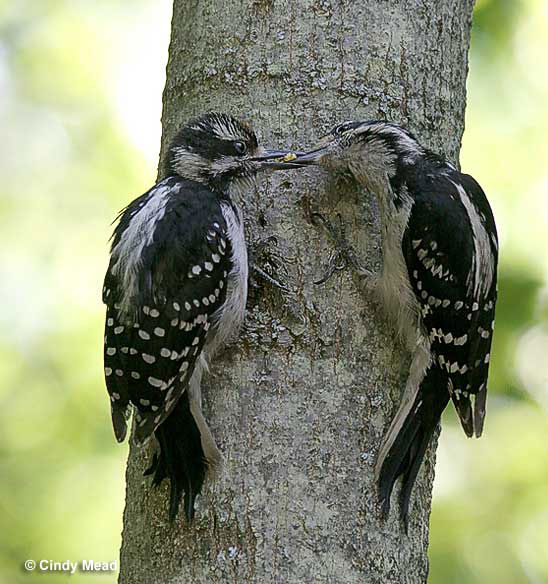
The nesting cavity is often in a stub or branch that is partially vertical; the cavity’s entrance hole is often on the underside. This location is believed to help prevent sapsuckers and flying squirrels from taking over.
Hairy Woodpeckers begin hollowing out their nesting areas less than a couple of weeks before egg-laying starts.
The entrance to the nesting site is about 2 inches deep and 1.5 inches across, leading to a cavity that’s 8 to 12 inches tall. The inside of the nest widens at the bottom to make room for the incubating bird and the eggs. It’s typically empty except for a bed of wood chips that the eggs and chicks rest on.
Hairy Woodpeckers typically have a clutch size ranging from 3 to 6 eggs. The incubation period for Hairy Woodpecker eggs lasts 11 to 12 days. After that, the young woodpeckers leave the nest after 28 to 30 days.
Current Situation
Hairy Woodpeckers are a widespread and common bird. From the late 1960s to 2019, their populations have increased by 0.7% every year. Their estimated breeding population is 8.9 million.
According to the IUCN Red List, Hairy Woodpeckers have an increasing population and are a species of least concern. This means they’re a species of low concern.
Even though this bird has healthy populations, there is some concern that competition for nest holes from European Starlings and the fragmentation of large forest tracts can cause problems for these birds.
Related: Types of Woodpeckers in North America
Hairy Woodpeckers are common in mature woodlands with large and medium trees. They also occur in suburbs, woodlots, cemeteries, and parks. You can find them in deciduous and coniferous forests up to around 6,500-foot elevation.
These birds are also around beaver ponds, forest edges, recently burned forests, open pine, southern swamps, orchards, and oak or birch woodlands.
Facts
- Hairy and Downy Woodpeckers have almost identical plumage. The best way to differentiate these birds is to look at the size; Downy Woodpeckers are smaller, have shorter bills than their head size, and have spots on their white tail feathers.
- Hairy Woodpeckers will sometimes follow Pileated Woodpeckers for food. They’ll wait for the pileated to excavate an area and then move on; once they leave, the Hairy will investigate the holes and consume any insects the pileated missed.
- Hairy woodpeckers can hear insects moving under the tree bark because of the vibrations they make.
- Hairy Woodpeckers have been observed drinking sap that leaked from wells that sapsuckers made. Additionally, they’ve been seen pecking sugar cane to drink the juice.
- When woodpeckers peck, it causes their skull to heat up. This is part of the reason why we see them peck in short bursts because they’re giving their head time to cool.
Similar Species
The Hairy Woodpecker has features that are similar to other bird species. Here are some similar species:
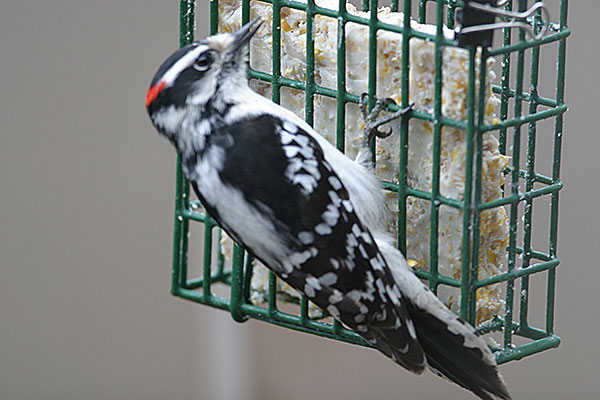
Downy Woodpecker Male
The primary difference between Hairy Woodpeckers and Downy Woodpeckers is their size.
Hairy Woodpeckers are notably larger, measuring around 7 to 10 inches in length, while Downy Woodpeckers are smaller, ranging from approximately 5 to 7 inches in length.
Additionally, Hairy Woodpeckers have notably longer bills that appear to be equivalent in length to the size of their head.
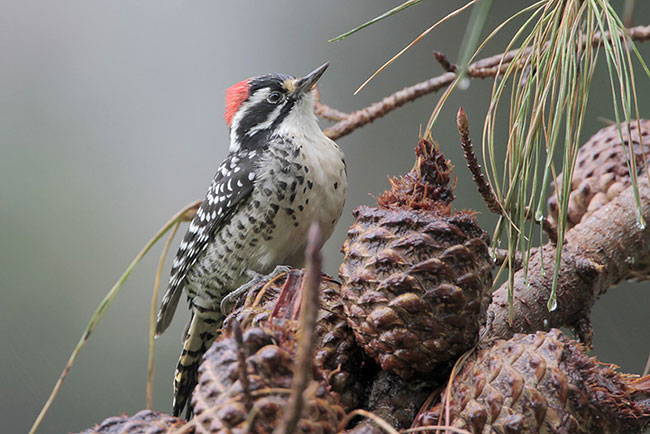
Nuttall’s Woodpecker
Hairy Woodpeckers and Nuttall’s Woodpeckers are frequently confused with each other.
Hairy Woodpeckers have a prominent white streak in the upper portion of their backs in the center, while Nuttall’s Woodpeckers have a black back with distinct white stripes.
Frequently Asked Questions
Why do they call it a Hairy Woodpecker?
The Hairy Woodpecker got its name from the thread-like, long white feathers that run down its black back.
What is the difference between a Hairy and a Downy Woodpecker?
Hairy and Downy Woodpeckers have almost identical plumage. The best way to differentiate these birds is to look at the size; Downy Woodpeckers are smaller, have shorter bills than their head size, and have spots on their white tail feathers.
Are Hairy Woodpeckers aggressive?
Hairy Woodpeckers can be aggressive towards Downy Woodpeckers. It’s theorized that that’s why Downy Woodpeckers and Hairy Woodpeckers look so similar. If a Hairy Woodpecker were to think that a Downy is a Hairy, that could help the Downy hold on to resources like territory and food.
Do Hairy Woodpeckers damage trees?
Woodpeckers, including Hairy Woodpeckers, rarely do damage to trees. Woodpeckers don’t consume trees; they consume the insects that live in them. Additionally, woodpeckers’ holes by themselves do not kill trees.