

Have you ever heard of the Great Crested Flycatcher? These birds cover a good portion of the United States but are less known than some other birds. They’re fascinating birds! Did you know that Great Crested Flycatchers intertwine snakeskin that’s been shed into their nests?
They don’t do this everywhere; they’ll only use snakeskin that is easily accessible, like in the state of Florida. They’ll also look for other crinkly, flimsy materials like plastic wrappers, onion skins, and cellophane.
These birds are common. They can be found in Southern Canada and Central and Eastern North America. They’ll migrate south for the winter to Central and South Florida, Central America, Colombia, and Southern Mexico.
Identification
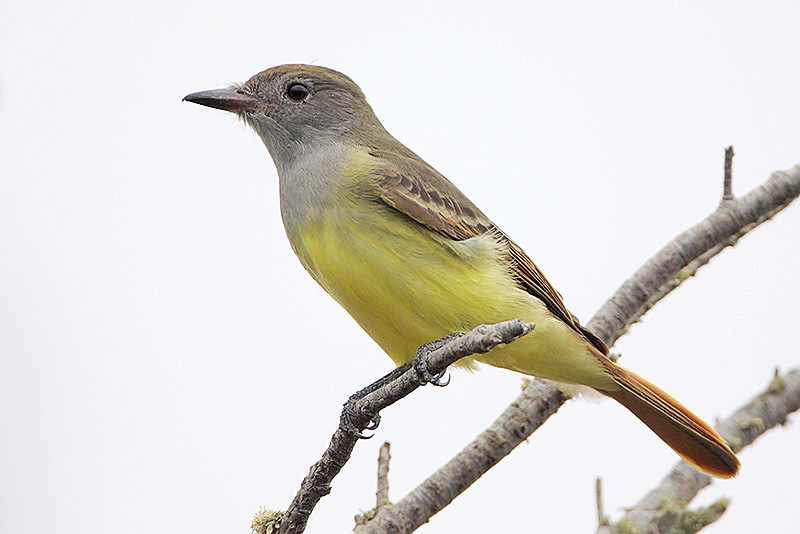
Male, female, and juvenile Great Crested Flycatchers look similar. They’re large flycatchers and are eye-catching because of their lean, long proportions.
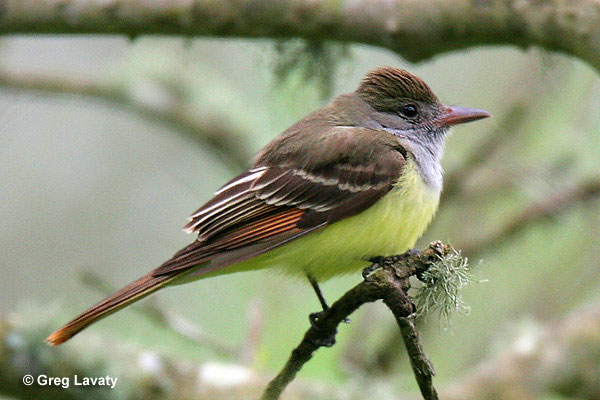
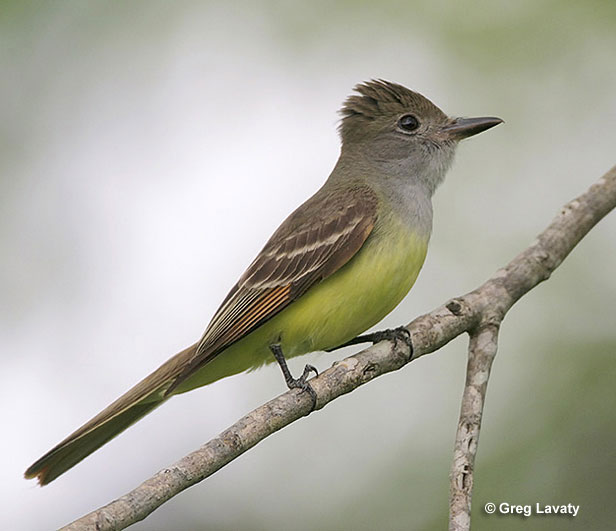
Like most flycatchers, the Great Crested Flycatcher has an impressive build with a large head and wide shoulders. Even though its name suggests it, this bird’s crest is not very notable. The tail is pretty long, and the bill is straight and wide at the base.
Great Crested Flycatchers have a brownish-gray head, gray breast, and throat, bright yellow belly, and are reddish-brown on top.
The brown upper parts are emphasized by an orangey color that’s also on the outer tail feathers. The bill is primarily black, but a pale color can be seen at the base of the bill.
Food
Great Crested Flycatchers have a broad diet, but they mainly eat insects. They’ve also been known to eat fruits like smaller berries and other invertebrates.
Fruits are a more significant part of their diet when they winter in the tropics. The fruits are eaten whole, and the pits are regurgitated after the fact.
Some insects that Great Crested Flycatchers are known to eat are moths, butterflies, grasshoppers, beetles, crickets, bees, spiders, and flies. These flycatchers will take the insects out of the air and off the surfaces of branches and leaves, haystacks, and tree crevices.
Moths, butterflies, and dragonflies are fed to chicks whole; if the chicks reject them, the parents will squash the insects and offer them again to the chicks.
Nesting and Eggs
Great Crested Flycatchers are cavity nesters; their nests can be anywhere from 2 to 70 feet off the ground. They prefer natural cavities; for example, they can be found in dead trees.
However, they will use nesting boxes, old woodpecker holes, and hollow posts. They’ve also been known to nest in pipes, buckets, boxes, and cans. Both the male and the female will inspect potential nesting sites.
The female does almost all of the construction, while the male Great Crested Flycatcher keeps her company.
If a nesting cavity has a depth greater than 12 inches, the female will backfill it with materials before building her nest. Various materials will be used for the nest, like leaves, grasses, stems, twigs, fur, hair, snail shells, sea shells, bark, feathers, moss, onion skin, cellophane, paper, eggshells, cloth, and snakeskin.
The inner cup of the nest is usually 3 to 3.5 inches wide and has a depth of 1.5 to 2 inches. The female Great Crested Flycatcher may continuously add materials like feathers throughout the entire nesting process.
- Clutch size can be anywhere from 4 to 8 eggs.
- Egg length can be anywhere from 0.8 to 0.9 inches (2.1 to 2.4 centimeters).
- Egg width can be anywhere from 0.6 to 0.7 inches (1.5 to 1.8 centimeters).
- Eggs are usually either off-white white or pinkish in color. In addition, splotches of lavender, brown, and purple are common.
Current Situation
Great Crested Flycatchers prefer mixed woodlands, open forests, and the edges of clearings. Dead or dying trees are crucial because they’re the preferred source of cavities for nesting. They’re not too concerned with humans and have been known to choose nesting cavities in golf courses, cemeteries, and parks.
If there are enough trees around, Great Crested Flycatchers will claim territories along rivers and streams, pastures, wetlands, and swamps. When they reach their wintering grounds, they extend the habitats they tolerate to clearings with scattered trees, semiarid forests, and shrubby clearings.
Great Crested Flycatcher numbers have remained stable throughout their range from 1966 to 2019. The estimated global population is 8.8 million, which means they’re a low-concern species.
There is a possibility of moderate local population increases due to the significant fragmentation of woodlands. This expands the edge habitats they prefer to live in.
Moderate local population decreases may happen due to Tree Swallows, European Starlings, House Wrens, squirrels, and Eastern Bluebirds competing for nesting cavities. Forestry practices to help areas look “clean” have reduced the amount of acceptable natural cavities by removing dead trees and snags.
However, Great Crested Flycatchers are hardy birds and will nest in various cavities. They tolerate the presence of humans and are happy to nest in nesting boxes.
Facts
- Great Crested Flycatchers actually eat quite a bit of fruit. You would think because of their name, they would favor flies, but they don’t. Even thorough these birds are flycatchers, they eat a fair amount of fruit. Great Crested Flycatchers don’t pick the flesh off fruits; instead, they swallow the fruit whole, even ones with pits! If the fruit contains a pit, it’ll just regurgitate later.
- Great Crested Flycatchers are a bird that prefers to be heard and not seen. So when a male sings, he’ll pick a perch inside the canopy to sing from. This perch usually sits a reasonable distance away from the end of a branch. Contrary to their singing perches, perches for hunting require a clear view of possible prey and flight paths to said prey. Both males and females favor using branches that are dead with foliage as a backdrop for said perches.
- Yearlings will choose a breeding area and return to the same area year after year. However, they will not breed near where they were born. Some Great Crested Flycatchers will reconstruct their bond, pair up again, and even use the same nesting cavity they previously used.
- Great Crested Flycatchers prefer to live on the borders of different habitats. This is because they don’t need large sections of forest canopy to thrive. Unlike most species, this is why development and logging practices that increases the fragmentation of forests actually work to this species’ advantage.
- The Great Crested Flycatcher is a bird that spends the smallest amount of time possible on the ground. You’ll almost always see them in the treetops. It also does not walk or hop. It also prefers to fly from one location to another.
Similar Species
The Great Crested Flycatcher has features that are similar to other bird species. Here are some similar species:
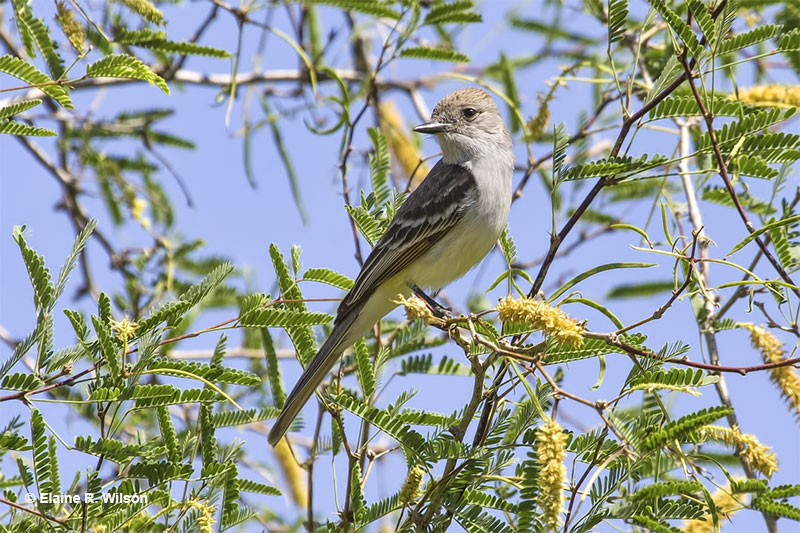
Brown-Crested Flycatcher © Elaine R. Wilson
Brown-crested Flycatcher – Brown-crested Flycatchers have paler bellies and paler chests than Great Crested Flycatchers.
When you see the tail from below, you’ll also see that the Brown-crested Flycatcher has a less orangey tail and more brown on the sides.
Brown-crested Flycatchers are not too common in the United States. They can be spotted in southern parts of the country.
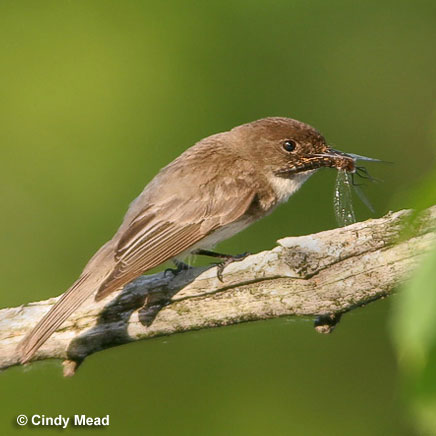
Eastern Phoebe
Eastern Phoebe – Eastern Phoebes are smaller than Great Crested Flycatchers.
They also have underparts that are whiter and do not have cinnamon in the tail or wings as Great Crested Flycatchers do.
Their ranges are pretty similar, but Eastern Phoebes tend to travel further into Canada.
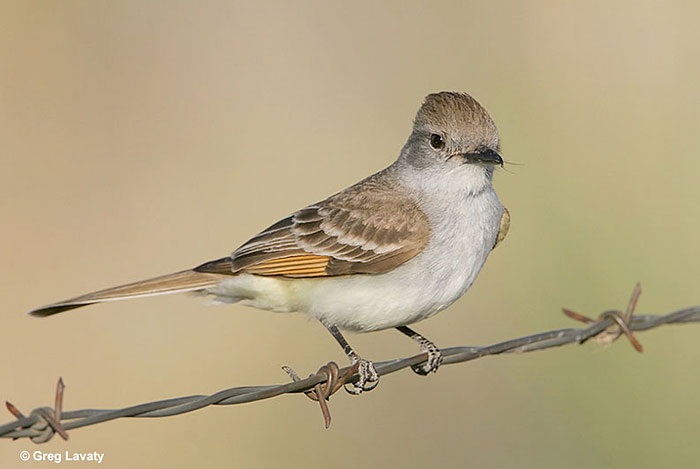
Ash-Throated Flycatcher
Ash-throated Flycatcher – Ash-throated Flycatchers are paler and smaller than Great Crested Flycatchers.
Their underbelly looks white, compared to the Great Crested Flycatcher’s yellow belly.
They also have a thinner and shorter bill.
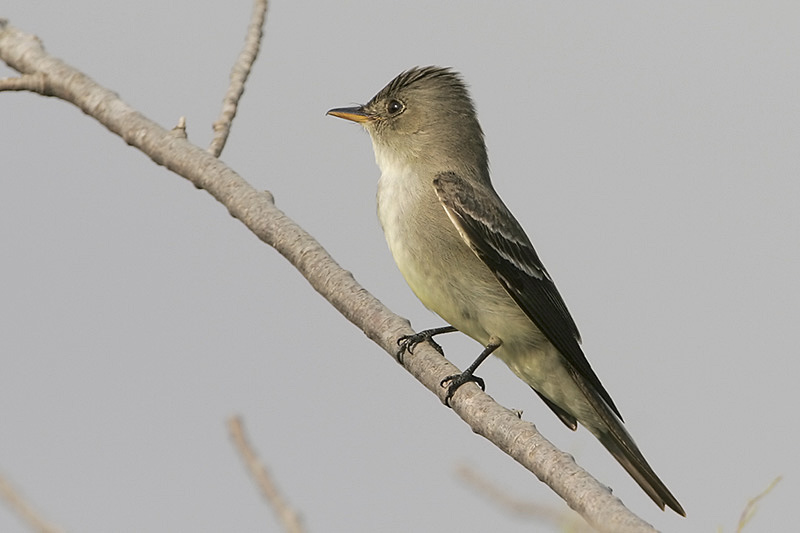
Eastern Wood Pewee Photograph © Greg Lavaty.
Eastern Wood-Pewee – Eastern Wood-Pewees are smaller than Great Crested Flycatchers.
They also have underparts that are whiter and do not have cinnamon in the tail or wings as Great Crested Flycatchers do.
The plumage tends to have more grayish colors, compared to Great Crested Flycatchers.
These two species do have a similar range, so it’s worth paying attention to some of the smaller details.
FAQ
Are Great Crested Flycatchers rare?
No, Great Crested Flycatchers are not rare. They’re a common bird but can be hard to see because they spend almost all their time in tree canopies.
Where do Great Crested Flycatchers live?
Great Crested Flycatchers live in Southern Canada and Central and Eastern North America. Then, they’ll migrate south for the winter to Central and South Florida, Central America, Colombia, and Southern Mexico.
How do you attract Great Crested Flycatchers?
Great Crested Flycatchers can have trouble finding nesting cavities. However, they don’t mind using nest boxes, so if you want to attract them, consider putting a nest box up. This can attract a breeding pair; just be sure to put the nesting box up before the breeding season starts.
How long do Flycatchers live?
The estimated lifespan for these flycatchers is 2 to 10 years.
How many flies does a Flycatcher eat a day?
Great Crested Flycatchers eat about a third of their weight every day in insects.