
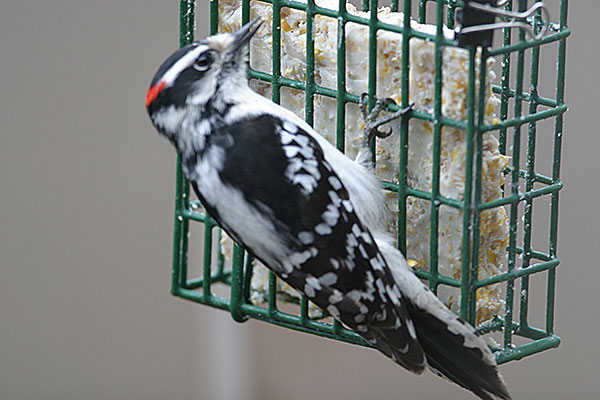

The Downy Woodpecker (Picoides pubescens) is a well-known bird for those with backyard bird feeders. Downy Woodpeckers have the classic woodpecker body shape on a smaller scale.
In addition, they have a chisel-like, straight bill, wide shoulders, straight-backed posture, and blocky heads. Like all woodpeckers, they lean away from tree trunks, tree limbs, and feeders onto their tail feathers.
You’ll find Downy Woodpeckers in every U.S. state and most of Canada. They prefer open woodlands, mainly where there are deciduous trees and brushy edges. However, they’re also comfortable making homes in orchards, backyards, vacant lots, and city parks.
Identification
Downy Woodpeckers are hard to differentiate because both sexes look very similar in many aspects. Males, females, and juveniles have a checkered black-and-white look.
The head is boldly striped, the upperpart and wings are black with white, and the back has a wide white stripe down the middle.
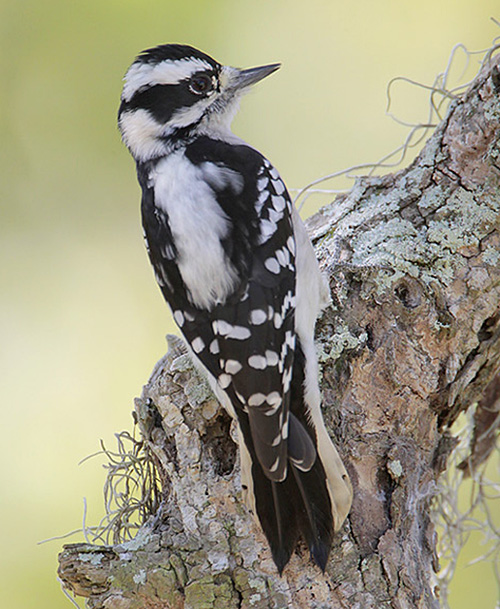
Photograph © Greg Lavaty.
The only telling difference between the gender is males have a small red patch on the back of the head, while females do not. The outer tail feathers are usually white and have only a few black specks.
Regional Differences
Downy Woodpeckers that reside in the West are overall darker in color. They also tend to have less white on the wings than birds from the east. Downy Woodpeckers residing in the Pacific Northwest have a dusky look overall.
Habitat
The Downy Woodpecker prefers to live in forests, willows, woodlots, river groves, shade trees, and orchards. However, they can be found in a wide variety of habitats, anywhere from wilderness areas to suburban yards.
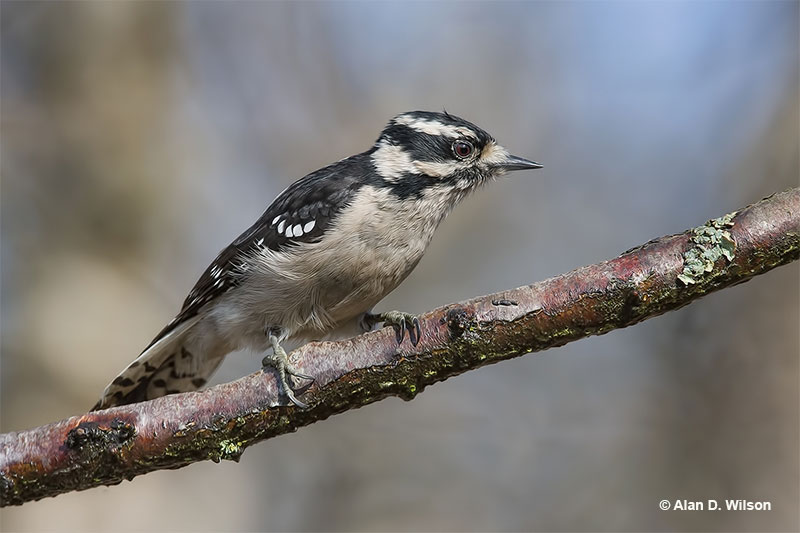
© Alan D. Wilson
Downy Woodpeckers usually make their nests in live trees with dead parts or completely dead trees. They typically nest in a small stump that remains on the tree that leans vertically. The entrance to the nesting cavity is placed on the underside of the stub. Nest trees are often overrun with fungus because it weakens the wood, which makes it easier for them to excavate.
Both female and male Downy Woodpeckers will excavate the hole for the nesting cavity. It usually takes one to three weeks to complete the job. Entrance holes are around one to one and a half inches across and are circular.
Cavities will be around six to twelve inches deep and widen towards the bottom. This is so room can be made for eggs and the bird that will be incubating. The cavity is lined with wood chips only.
Diet
A Downy Woodpeckers’ diet mainly consists of insects. Woodpeckers are known to eat beetles and ants. However, they do eat a wide variety of insects. Some include gall wasps, beetle larvae, caterpillars, corn earworms, bark beetles, tent caterpillars, and apple borers. Around one-quarter of their diet consists of grains, berries, and acorns.
Downy Woodpeckers will frequently visit bird feeders, eating nuts, suet, and even black oil sunflower seeds.
Behavior
These woodpeckers are very active and can often be seen quickly moving over tree branches, wildflower and grass stems, and trunks.
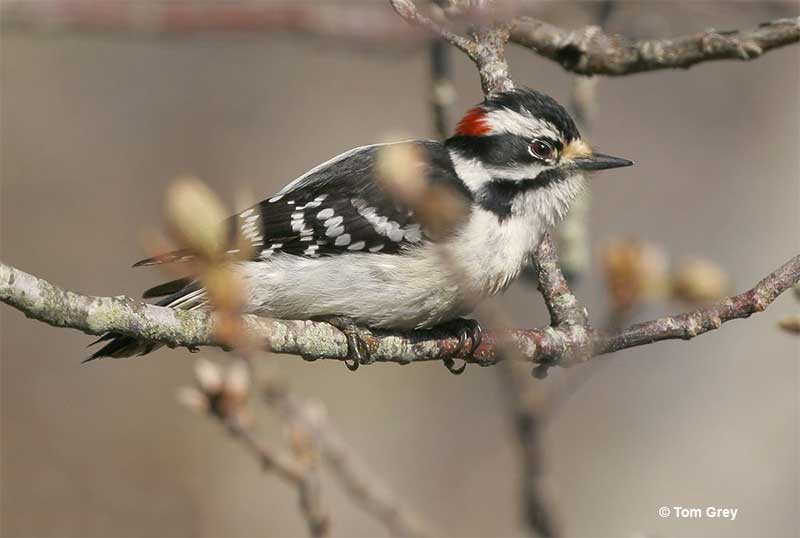
However, Downy Woodpeckers differ slightly in their behavior compared to other woodpeckers; they move downwards and horizontally on trees instead of vertically and upwards.
In the late Summer, they can also be seen perched on tall weeds like goldenrod. These weeds have larvae inside, so they’ll hammer away at a plant gall to access them. Occasionally, Downy Woodpeckers will hop on the ground in search of food.
Related: Why do woodpeckers peck wood?
Downy Woodpeckers have a smooth flight pattern that is typical of many woodpecker species, alternating by folding the wings against the body and quick wingbeats. When disputing with other birds, Downy Woodpeckers will raise their head feathers, jerk their beaks from side to side, and fan their tails.
In the spring, male and female Downy Woodpeckers will participate in courtship displays where they both fly between trees with slow wingbeats that look almost like butterfly wingbeats.
Range (and seasonal changes)
One of the most widespread North American woodpeckers, the Downy Woodpecker, can be found year-round throughout the United States. From the tree line in Alaska and Canada to the riparian forests of southern California and southern Florida.
Fun Facts
- Downy woodpeckers are the smallest woodpecker in North America.
- During the winter, Downy Woodpeckers are commonly seen in flocks of several species of birds. This allows them to spend less time watching out for predators and gives them better luck at finding food.
- Woodpeckers don’t sing like songbirds do. Instead, they loudly drum against pieces of metal or wood. People think this drumming is part of their feeding process, but it’s not. In fact, when feeding, they make minimal noise, even when intensely digging into wood.
- Downy Woodpeckers have been documented nesting inside building walls.
- The oldest bird of this species was at least eleven years and eleven months old. He was first banded in California in 1985. He was captured again in 1996 and released during banding operations in the same state.
Vocalization
The Downy Woodpecker has a whinnying call, almost like a horse, that both males and females make. It’s a string of high-pitched yet hoarse notes that descend in pitch at the end. This call lasts about two seconds.
Both male and female Downy Woodpeckers drum on trees to claim their territory and attract mates. The drumming happens from rapid strikes the bird makes against a surface at a steady pace.
The birds also make deliberate, slower, and much quieter tapping sounds when excavating. Downy Woodpeckers who are excited can even produce a “wing ruffle” sound while in flight.
Similar Species
There are some species that are quite similar to the Downy Woodpecker, but you can distinguish them upon taking a closer look.
Related: Types of Woodpeckers
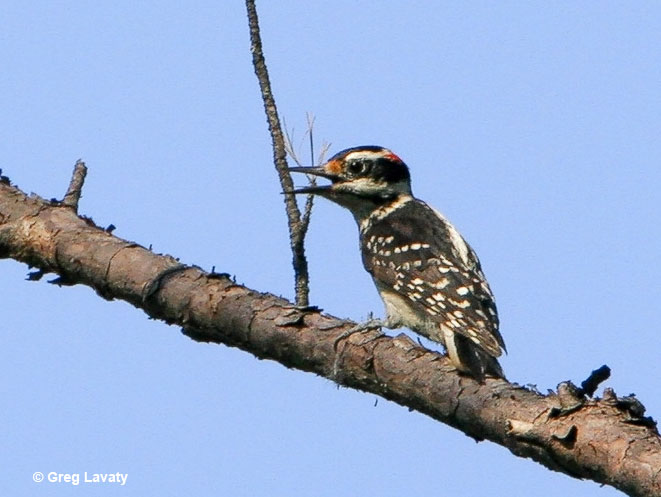
Hairy Woodpecker
While Hairy Woodpeckers are similar to Downy Woodpeckers, but Downy Woodpeckers are larger with larger bills and a louder voice.
Learn more: Downy vs Hairy Woodpeckers
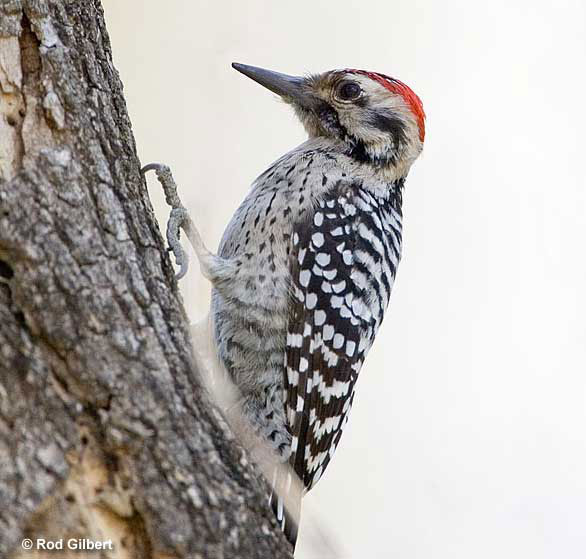
Ladder-backed Woodpecker. Photograph © Greg Lavaty.
Downy Woodpeckers can look similar to Ladder-backed Woospeckers, but they still have significant differences.
Downy Woodpeckers have white on their backs, and their chest and belly are generally white, whereas Ladder-backed Woodpeckers have a striped back and a speckled belly.
Their heads have different plumage too – Downy Woodpeckers have a small patch of red in the backs of their heads, while Ladder-backed Woodpeckers have a long red stripe on heir heads.
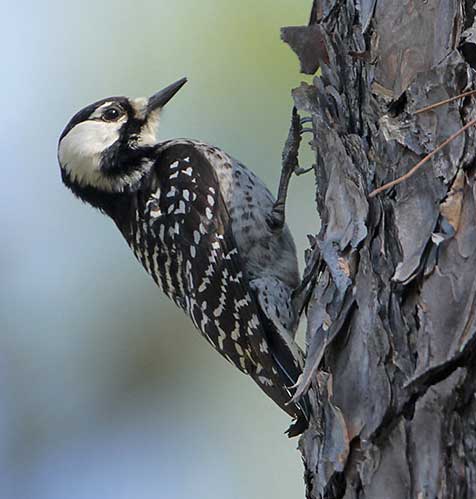
Female Red-Cockaded Woodpecker. © Greg Lavaty
Compared to Downy Woodpeckers, Red-cockaded woodpeckers have a larger build and slightly different plumage.
Red-cockaded have a white stripe on their backs and lack Downy Woodpeckers’ eye stripes.
Frequently Asked Questions
What does a Downy Woodpecker look like?
Downy Woodpeckers have a checkered black-and-white look. The head is boldly striped, the upperpart and the wings are black with white, and the back has a wide white stripe down the middle. The only telling difference between the gender is males have a small red patch on the back of the head, while females do not.
How rare is a Downy Woodpecker?
Downy Woodpeckers are not rare; they are very common. They’re regularly seen in backyards, neighborhoods, parks, and the woods.
Where do Downy Woodpeckers live?
The Downy Woodpecker prefers to live in forests, willows, woodlots, river groves, shade trees, and orchards. However, they can be found in a wide variety of habitats, anywhere from wilderness areas to suburban yards.
Are Downy Woodpeckers friendly?
Downy woodpeckers are naturally skittish birds at first. However, they can become very friendly. They have been known to eat out of people’s hands and be comfortable enough to hang around feeders when people are in their yards. You just have to show patience and let them see you.