
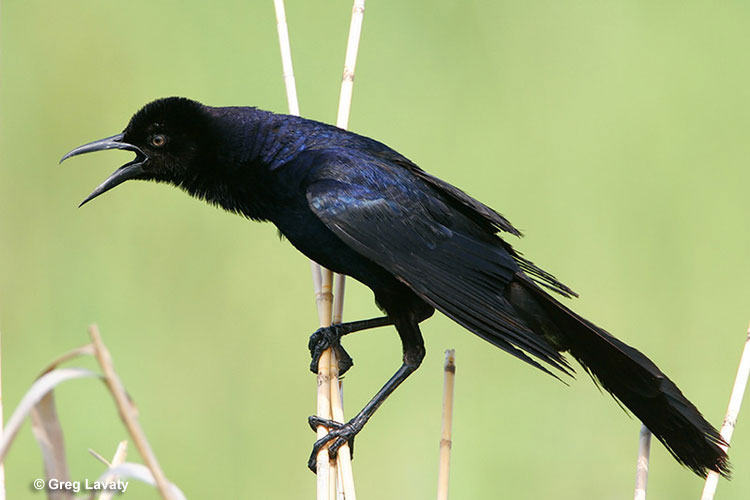

Boat-tailed Grackle males are so much larger than females, and so different in color, that they might not be immediately recognized as belonging to the same species. Aspects of Boat-tailed Grackle breeding biology are unusual, with females nesting in synchrony in colonies located in predator-safe areas such as small, vegetated islands.
Boat-tailed Grackles have 10 or more songs, but the meanings of the different song types are not well understood. Males sing throughout the year, and females rarely sing
On this page
Description of the Boat-tailed Grackle
BREEDING MALE
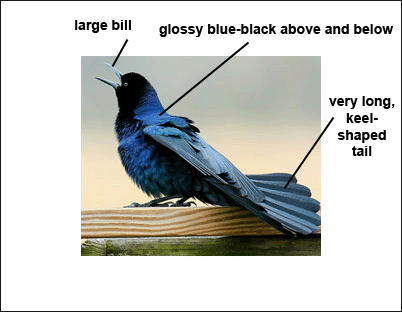
The Boat-tailed Grackle is sexually dimorphic, and it is a large blackbird with a very long, keeled tail. Northern birds have pale eyes, while Florida and Gulf Coast birds have dark eyes.
Males are much larger than females, and are entirely blackish, with a purple gloss to the head and greenish gloss to the body. Length: 14 in. Wingspan: 16 in.
Female
Females are smaller than males, and are rusty-brownish in color with darker wings. They have a dark line through each eye.
Seasonal change in appearance
None.
Juvenile
Juveniles resemble winter females.
Habitat
Boat-tailed Grackles inhabit beaches and coastal marshes.
Diet
Boat-tailed Grackles eat a widely varied diet, including aquatic insects, mussels, frogs, eggs, and seeds.
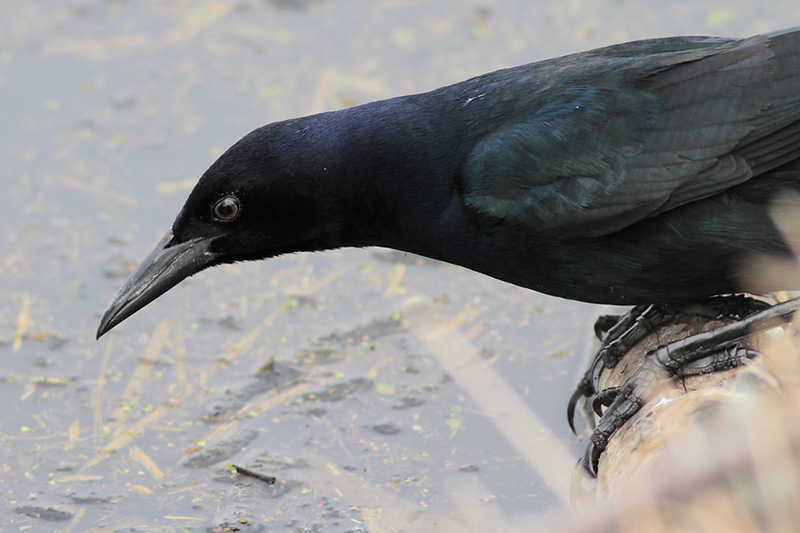
Photograph © Greg Lavaty.
Behavior
Boat-tailed Grackles forage on the ground or in shallow water.
Range
Boat-tailed Grackles are resident along most of the mid-Atlantic and Gulf Coasts of the U.S. The population is stable or increasing, and has expanded its range north in recent decades.
More information:
Bent Life History
Visit the Bent Life History for extensive additional information on the Boat-tailed Grackle.
Wing Shape
The shape of a bird’s wing is often an indication of its habits and behavior. Fast flying birds have long, pointed wings. Soaring birds have long, broad wings. Different songbirds will have a slightly different wing shape. Some species look so much alike (Empidonax flycatchers) that scientists sometimes use the length of specific feathers to confirm a species’ identification.

Wing images from the University of Puget Sound, Slater Museum of Natural History
Fun Facts
Boat-tailed Grackles were once considered to be of the same species as Great-tailed Grackles, but their ranges overlap along the western Gulf Coast and they do not interbreed.
There are four subspecies of Boat-tailed Grackles, helping account for the differences in eye color.
Vocalizations
The song consists of a series of high “kent” or “reet” notes as well as a variety of trills and rattles. A “chuk” call is given as well.
Similar Species
Great-tailed Grackle
Great-tailed Grackles are nearly identical. Ranges overlap along the Texas and Louisiana coast. Where ranges overlap, Boat-tailed eyes are dark, Great-tailed eyes are green.
Great-tailed Grackle
Great-tailed Grackle females are not as reddish-brown as female Boat-tailed Grackles.
Common Grackle
Common Grackles are considerable smaller.
Nesting
The Boat-tailed Grackle’s nest is a cup of twigs, grass, rushes, and weeds and is lined with finer materials. It is placed in bulrushes, cattails, or shrubs near water.
Number: Usually 2-3.
Color: Greenish-blue in color with darker markings.
Incubation and fledging:
The young hatch at about 13-15 days, and fledge at about 12-15 days, though remaining dependent on the adults for some time.
Bent Life History of the Boat-tailed Grackle
Published by the Smithsonian Institution between the 1920s and the 1950s, the Bent life history series of monographs provide an often colorful description of the birds of North America. Arthur Cleveland Bent was the lead author for the series. The Bent series is a great resource and often includes quotes from early American Ornithologists, including Audubon, Townsend, Wilson, Sutton and many others.
Bent Life History for the Boat-tailed Grackle – the common name and sub-species reflect the nomenclature in use at the time the description was written.
Florida Boat-Tailed Grackle
CASSIDIX MEXICANUS MAJOR (Viejilot)Contributed by ALEXANDER SPRUNT, JR.HABITS
With the recognition of the Atlantic coast population of the boat tailed grackle as racially distinct, only a remnant of what was formerly considered the range of the Florida race is left to it: Florida and the Gulf coast west to Galveston and Port Arthur, Tex. Along the Gulf coast its distribution is at times discontinuous. A. H. Howell (1932) found it common at only one locality between Pensacola and Cedar Keys, i. e., at St. Marks, which lies on the Gulf, south of Tallahassee. F. M. Weston writes me (MS.) that “The boat-tailed grackle is so rare m the Pensacola region that I had been located here for ten years before I saw one. Having once found them, I was able to establish the fact that the species is resident here in very small numbers, for I have seen them in every month of the year at some time during the past 18 years.” He further states that, in contrast to the scarcity about Pensacola, the bird is “enormously abundant in the vast fresh marshes at the head of Mobile Bay, about. 60 miles west, and common all the way down both sides of the Bay to the restricted salt marshes just behind the Gulf beaches.”
While collecting about Choctawhatchie Bay, about 70 miles east of Pensacola, Worthington and Todd (1926) found that “this species was not detected on the north side of the bay * * * but * * * on the south,” where a flock of “about twenty birds, mostly females, was encountered on May 4th * * * and two specimens were secured.” The Pensacola region shows some surprising ornithological gaps, and the occurrence of the boat-tail in that area is illustrative.
Westward from Mobile along the coast it is abundant, and no difficulty is experienced in observing it almost anywhere. Curiously enough, it does not appear to winter very commonly on the Mississippi coast although a common breeder. T. D. Burleigh (1944) says: “Despite the comparatively mild winters and no apparent scarcity of food, very few of these birds remain on this part of the coast during the winter months. The last small flocks are usually seen late in October, and it is the last of February or even later before they reappear again. On Deer Island [Miss.] I noted the Boat-tailed Grackle only once during the winter months. * * * It is possible that these grackles winter more commonly on the outer islands. * * * On the mainland and Deer Island, February 22 is the average date of arrival in the spring.”
Courtship: The courtship antics of this race are similar to those described for the eastern form (see p. 366). A great variety of locations may be used by the displaying or singing bird; E. A. Mellienny, (1937), writing about the bird in Louisiana, gives a clear picture of such proceedings as follows:
Their favorite station for plumage exhibition is the top of a small bush or low tree. If these are not available, they will alight on the ground or on a muskrat house or pile of debris. Here they stay quietly for some minutes, with their feathers compressed and beak and neck pointing skyward, then suddenly one of them will give a series of squeaking, chuckling, raucous cries, during which all the feathers are fluffed, tail spread, wings half opened and vibrated rapidly, making a loud, rattling sound [see Voice]. The others of the group immediately follow the leader’s example, and for a minute or two each individual is animated and noisy, only to drop back to the compressed statuelike pose. This noisy exhibition takes place either while at rest or on the wing.* * *
If, over such a group of males, flies a female seeking a mate, all of the males at once take flight on loudly flapping wings and with rattling quills, squeaking and calling in their most seductive manner, begin chasing her. Should none of this group of males attract her, she quickly out flies them and proceeds to look over other groups until she finds her choice. When a mate is selected she flies in front of and near him, leading him off to one side, until the other males in the group drop out of the chase. The pair then alights on the ground and mating is accomplished .
This race, like the eastern one, is more or less polygamous, as may be inferred from a statement by C. J. Pennock (1931): “Observe a glistening old male atop a buttonbush, in a sawgrass marsh, his seraglio close under his view.” Brooks (1932) commenting on this, said, “the implication of polygamy in Mr. Pennock’s concluding paragraph also calls for investigation. Seraglios are always interesting. Is it possible that we have at our very doors an Icterine with the fascinating habits of an Oropendola?” It is indeed possible.
E. A. Mcllhenny (1937), however, remarks that, “the boat-tailed grackles are not monogamous; neither are they polygamous. They seem to be promiscuous., The female chooses her mate, who is decidedly temporary, and as soon as sexual mating is accomplished, she leaves him, and he does not attempt to follow.” On the other hand, S. A. Grimes writes (MS.) that in his opinion, “the Florida birds * * * are polygamous rather than promiscuous in breeding habits.” Thus, even experienced observers differ about polygamy and promiscuity.
Courtship takes place in early February in Louisiana, and in south Florida activity among the males usually starts about the middle of that month, though forward and backward seasons may vary the time. Courtship has been noted at Lake Okeechobee in late January, but a month later is more normal .
Nesting: The nesting habits of the Florida boat-tail are similar to those of the eastern race (see p. 367). In the Lake Okeechobee area of Florida, the birds often nest in willows.
Eggs: Unlike the eastern grackle, for which four or even five eggs have been reported in many nests, three is the usual number of eggs for the Florida race. E. A. Mcllhenny (1937) states that in Louisiana the complement of eggs is “invariably three,” although he once did find four in a nest. The eggs are identical with those of the eastern boat-tailed grackle.
Incubation: E. A. Mcllhenny (1937) says: “The male pays not the slightest attention to the female after copulation is accomplished; neither does he visit the nesting location in the early part of the nesting season with any regularity, nor does he assist in the building of the nest or in the care of the young.” He prefaces these observations by stating that in its courtship and lack of attention to the young, “the Boat-tailed Grackle differs from any other American bird I have ever observed.”
S. A. Grimes of Jacksonville, Fla., writes (MS.) that he has “never seen a male mexicanus of any race lend a hand in any manner to assist in nest-building, incubation, or care of the young,” and Ivan R. Tompkins of Savannah, Ga., tells me (MS.) that no male he ever collected had “worn incubation patches.”
As might be expected, the peculiar breeding habits of the boat tailed grackle is reflected in the sex ratio of the young. In a polygamous species one would expect a preponderance of females, and such is normally the case with the boat-tail. Illustrative of specific figures in this regard, Mellhenny (1940), who checked 89 nests at Avery Island, La., and found that the hatch comprised 70 males and 145 females, rather more than a 2-to-i majority. In his extensive banding operations Mcllhenny found this ratio consistently carried out in trapped birds. In 1935 and 1936 he banded 1,848 boat-tails, of which 609 were males and 1,239 females, practically the same proportion. He adds the interesting observation that banding has proved that “while the females of the previous year nest as yearlings, the males do not reach the breeding age until the second year.”
Another characteristic at which I have often wondered is the unusual percentage of infertile eggs in nests of the boat-tail. On many an occasion, when investigating the home life of this bird and examining nests of young, I have found at the bottom an unhatched egg or even two; and now and then a search of the nests after the season has revealed these lonely reminders of an unborn progeny. I have not heretofore mentioned this in print, nor have I ever made any systematic count of the occurrence of this peculiarity. The only author who ever has, as far as I know, is E. A. Mclllienny (1937), who found in one Louisiana colony that” twelve out of nineteen nests examined contained one egg each that did not hatch, and three out of nineteen * * * contained two.” lie also found that in the first nesting there were no infertile eggs, in the second an occasional one, while in the third, “the majority of nests contained one or more infertile eggs.” It may be that the unique breeding habits of the male are reflected in this manner, or perhaps these are examples of lowered vitality, decreased virility, and the like.
Plumages: The comments given in our account of the eastern race of this species apply to this one as well (see p. 368).
Food: In his full and interesting study of the boat-tail in Louisiana, E. A. Mellbenny (1937) notes that the food supplied to the young “varies considerably. On some days it is almost exclusively small fish; on other days it may be spiders, and on still other days almost entirely crickets, grasshoppers or other insects. * * * Then again, when a batch of dragon-flies (either Libellula or Diplax) is coming off, the food supply consists entirely of dragonfly nymphs. On other days, if tadpoles or small frogs are especially abundant, these will constitute the food for the young. The Cricket Frog (Acis crepitane) is the one most used. I have not seen seed or grain or plant food fed to the young.” He adds that caterpillars are taken now and then by boat-tails, which in so doing perform a distinct service to agriculture. He says: “Frequently, in the autumn, fields of soybeans may be infested by great numbers of caterpillars which sometimes destroy the entire bean crop. When the Boat-tails find such an infestation they flock to these fields in enormous numbers and do not leave them until all caterpillars are eaten.” Thus, while some of the bird’s food habits may not seem to be of marked benefit to man’s interests, this, at least, certainly is, and so is the bird’s destruction of such insects as crickets and grasshoppers.
Behavior: Like the eastern race, this boat-tailed grackle stays fairly close to water. It goes further inland from the coasts, wherever streams or ponds occur, but the only area where it really penetrates far into the interior seems to be in Florida. Occurring on both coasts, the birds are scattered across and through the Peninsula, and one finds it wherever there is any swampy or river-lake habitat. However, it is very much of a city bird as well as rural, and is found breeding in Jacksonville, as well as at practically every small farm on the east coast of Florida. In its tendency to feed and to spend most of its time on the ground this bird is also like its eastern counterpart. It is at times predatory, not only attacking other birds but even on occasion practicing cannibalism.
Interesting instances of preying on other birds are given by E. A. Mcllhenny (1937), who states that the first instance he witnessed occurred in 1911, while he was in the company of George Bird Grinnell, on the coast of Louisiana. “We were in my big launch,” he says, “anchored * * * off the mouth of Bayou Michow. Near the boat was a stake * * * on which a swallow had alighted. A male Boattailed Grackle flew out from land, coming to the stake to alight. The swallow did not move until the Boat-tail was almost upon it, when it spread its wings, but the Boat-tail gave a quick snap and killed it * * *ï The grackle sat on the stake a half minute or so looking at its victim floating on the water, then swooped down, picked it up and went ashore with it.” He adds that he has “frequently seen male Boat-tailed Grackles feasting on ducks that had been killed and drifted to shore.” The muskrat trappers of Louisiana complain that these birds ruin the pelts of caught animals by pecking into them and eating the flesh. The writer heard many such complaints from trappers in Cameron Parish when investigating muskrat trapping there in 1934, and was shown some animals which had been thus disfigured.
Injured birds are taken by the boat-tailed grackle when opportunity offers, and Mcllhenny lists broken-winged red-backed sandpipers (Pelidna alpina sakhalina) as such victims. Even its neighboring redwings are not safe from it, as the same author has seen grackles devour young in the nest while the impotent parents strove vainly to drive away the marauder. It is also a confirmed egg thief and seeks out heron, egret, and other such nests to indulge this appetite. On the Texas nesting islands I have often seen the boat-tailed grackle despoiling nests of the reddish egret. In such instances it is not so much the predation of the grackle as the attitude of the egret which is interesting, for the latter simply stands by with a most fascinated expression and calmly watches the proceedings, making not the slightest effort to interfere with them! Much to my surprise, I discovered osprey-jaeger tactics among these grackles in the Lake Okeechobee area, in Florida, while conducting Audubon wildlife tours there in 1941. One of the tour routes lay along the road which skirts the northern shore of the Lake and a great attraction of it was the fact that flocks of feeding eastern glossy ibis (Pie gadis guarauna) were to be seen every trip. These flocks, often associated with snowy egrets (Egretta thula thula) , were attended by numbers of boat-tails as they probed about for crayfish.
When an ibis secured a crayfish it would, instead of gulping its prey at once, spring into the air and fly upward. Instantly, it would be beset by grackles which almost invariably either snatched the crayfish from the ibis’s beak or forced it to be dropped, whereupon another of the tormentors would seize it. This victimization, not simply an isolated occurrence, was indulged in regularly and we saw it many times. Always, from the observer’s standpoint, it was a. spectacular performance, and at some little distance the birds looked like great grains of dark corn popping from a giant popper.
At times the boat-tail bedevils species much larger than itself, setting upon them and driving them off with vituperative and vociferous energy. Audubon relates that he has watched “seven or eight of them teasing a Fish Hawk for nearly an hour, before they gave up the enterprise.” It is not unusual to see them converge on turkey and black vultures (Cathartes aura septentrionalis) and (Coragyps atratu), these slow-moving unfortunates having no protection from their nimble and persistent tormentors but flight.
The boat-tail often feeds in close proximity to cattle, both in barnyards and on the open range, principally to secure the insects disturbed by the animals’ feet. Whether they actually take ticks from the hides of cattle I am not sure, but I have, on many occasions, seen them alight on the backs of cows. The Florida crow (Corvus brachyrhynchos pascuus) definitely secures ticks in this manner and is highly regarded in the cattle sections of that State as an aid in controlling the screwworm. About Lake Okeechobee the cattle are fond of entering the drainage canals, which are choked with water-hyacinth (Eichhornia crassipes); from knee to shoulder depth, there, standing in water they feed to repletion on this plant. At such times one can see numbers of boat-tails about them, walking about on the floating vegetation or actually perched on the animals’ backs, snapping up insects stirred up by their movements.
Albinism occurs in this form as in the eastern race (see p. 371). During February and March 1946, such an individual was observed on six occasions on the north shore of Lake Okeechobee, Fla., always within one hundred yards of the same spot.
Voice: The voice of this bird is similar to that of the eastern race (see p. 371), including the characteristic rolling or rattling sound, as may be seen from the following accounts. A. H. Howell (1932) describes a bird he heard near Jupiter Inlet, Fla., as ending its song “by a peculiar, guttural, clattering sound that. seemed to be of vocal origin, though accompanied by a fluttering of the wings.” E. S. Dingle (1932) remarks: “Besides the great number of sounds that issue from its throat, one frequently hears a curious rolling noise, made by the wings when the bird is perching, but occasionally during flight.” F. M. Chapman (1912) has likened this “singular rolling call” to the sound produced by a coot in pattering over the water.
That it is instrumental, indeed, is the first impression experienced by all who have written about it, hut to those who have followed it subsequently it is plain that this is not the case. The two most concise and detailed accounts of recent years are those of Francis Harper (1920) and C. W. Townsend (1927).
Harper says that while studying this grackle’s voice in Florida he:
Began to pay close attention * * * particularly to that part of it which Chapman describes as a “singular rolling call, which bears a close resemblance to the sound produced by a Coot in pattering over the water”. * * * I noticed that the bird * * * vibrated or slightly fluttered its wings, so that their tips appeared to strike either together or against the upper side of the tail. At the same time the bill had the appearance of partly closing. I therefore concluded that the sound was not vocal, but wing-made; a number of subsequent observations strongly confirmed me in this opinion.
It was not until my last morning in Florida * * * that I was undeceived. I then had an excellent view of a bird * * * and saw that it’s wing-tips did not touch during the final part of the song, though they vibrated a little. A little later another bird * * * did not appear to vibrate its wings at all * * *. I could plainly see the bill in a sort of rattling motion, however, and finally realized that it was the rapid striking together of the mandibles that produced the sound.
Almost identical with Harper’s first impresions and following conclusions, are those of Bradford Torrey (1894) who says, in writing of this sound, “that the sounds were wing-made I had no thought of questioning. Two days afterward nevertheless, I began to doubt. I heard a grackle ‘sing’ in this manner * * * wing-beats and all, while flying * * * and later still, I more than once saw them produce the sounds in question without any perceptible movement of the wings, and furthermore, their mandibles could be seen moving in time with the beats. * * * My own * * * conjecture is that the sounds are produced by snappings and gratings of the big mandibles.” Townsend (1927), who quotes both Harper and Torrey on the matter studied the sound both in Florida and South Carolina, and he too was at first under the impression that the noise the wing made, for he says in his field notes that “they flutter their wings slightly, making instrumental music in the form of a rattle.” Later observations, however, caused him to change his mind, for he says:
On several occasions I noticed that during the rattle the wings were sometimes moved but little, or were motionless. Once or twice I saw one wing slightly elevated but not vibrated. I also heard the rattle many times given in flight, and there was no perceptible modification of the actions of the wings at the time. I think it can be definitely stated therefore, that the evidence eliminates the wings from any causative action of the rattle, although the vibrating movement is generally present and exactly synchronous with it. * * * But my observations lead me to think that the rattle is vocal, modified by throat vibration and not made with the bill.
Enemies: S. A. Grimes of Jacksonville, Fla., writes that at times nests of the Florida boat-tail are invaded by black ants. He says that while examining a colony near Jacksonville Beach, “the northernmost outpost of the brown-eyed birds,” he found that “black ants had taken possession of all the nests, filling the interstices with their larvae and pupal cocoons. Only one grackle had held out against the ants. The eggs in her nest were pipped, but it was evident the young stood little chance of survival.”
These specific reasons why many young do not survive hardly suffice to explain the high mortality among nestling boat-tails. Facts on this phase of the life history are almost totally absent from the literature. I must confess never having mentioned it, and in this respect am as much at fault as any. Melihenny (1937), who has spent much time in observing the bird and its habits in Louisiana, found in a detailed study of 74 nests on Avery Island, La., that success in raising young was only 54 percent; only 20 nests raised 3 young from that number of eggs; 26 raised 2 young; and 5 nests, 1 young. In 23 nests the entire setting was lost; nor could he discover the reason.
One possible cause for the loss of eggs is suggested by Grimes’ notes. He states that while investigating nesting boat-tails in the Amelia River marshes of Florida he found “six or eight nests, some with and others without, fragments of eggshells. * * * Worthington’s Marsh Wrens (Telmatodytes palustris griseus) were numerous in the marsh and may have been guilty of the egg puncturing.”
Melihenny (1936) lists the purple gallinule (Iorwrnis martinica), as well as “many other species,” as preying on young boat-tails, and gives the following interesting example:
On Sunday, May 10, Stanley Solar and I were observing a large colony of nesting Boat-tailed Grackles. * * * We had already remarked the large number of empty nests, that the Sunday before, had contained small birds. We beard a young grackle crying in distress, and on going toward the place from where the noise came, saw a Purple Gallinule standing on the edge of the nest holding with one foot a half-grown grackle while it deliberately tore at its back with its beak. On our nearer approach, the gallinule took the still living young grackle in its beak and flew with it about 75 yards to the pond’s bank, where we watched it tear it to pieces and eat it. It first tore a hole in the back of its victim, and pulling out the viscera in sections. swallowed the pieces as they came free. It then tore bits of tender flesh from the body, paying no attention to my approach in a boat to within about sixty feet of it.
Field marks: Essentially similar to its eastern counterpart (see p. 373), this race may be distinguished in the field by the iris, which is dark brown, whereas it is yellow in the eastern one.
DISTRIBUTION
Range: The Florida boat-tailed grackle breeds and is mainly resident, but wandering in winter, along the shores of the Gulf of Mexico from southeastern Texas (Galveston, Port Arthur), southern Louisiana (Ged, Madisonville), southern Mississippi (Bay Saint Louis, Deer Island), southern Alabama (Chuckvee Bay, Alabama Port) to Florida (Bay County); south to the Florida Keys .
Egg date8: Florida: 41 records, March 3 to June 4; 24 records, March 20 to April 16. Texas: 103 records, April 3 to June 9; 54 records, May 1 to May 22.
Eastern Boat-Tailed Grackle
CASSIDIX MEXICANUS TORREYI Harper
Contributed by ALEXANDER SPRUNT, JR.
HABITS
During my boyhood I was accustomed to spend each summer on Sullivan’s Island, a beach resort across the harbor from Charleston, S. C. This stretch of sea sand, bearing little vegetation other than bushes,, small trees, and grass, has bulked largely in history for here was th~ palmetto-log fort which, commanded by General William Moultrie, saved Charleston from British invasion in 1776 by beating off the fleet of Sir Peter Parker. Again in the 1860’s Fort Sumter, a few hundred yards off the eastern end of the Island and directly in the bottle-necked harbor entrance, withstood for four years the attacks of the Federal fleet.
It was along the beaches of this Island, front and back, that I made my first field studies of the birds of the Carolina Low Country. As a boy I roamed Sullivan’s Island from end to end and across, haunting its inlets, its myrtle thickets, and its grassy flats. There I began my life list and there I started, as what boy has not, my first collection of eggs. The first “cabinet” for this collection was a deeply cupped nest of what we called the “Jaekdaw,” a name by which many southern coastal dwellers still know the boat-tailed grackle. In it were treasured specimens (one of each, blown with a hole at each end) of eggs of the nesting birds of the Island. Thus it was that this grackle was literally one of the first avian species I came to know, and this association continues today, for it is a daily sight about my home. Long contact has not diminished my interest for there is much about this fine bird to attract and hold the attention of any student of ormthology. Its handsome plumage, remarkable vocal efforts, and peculiar breeding habits all combine to make it an object of unusual interest .
Spring: The boat-tailed grackle is not much of a migrant. Just what volume of movement may take place from the south Atlantic area to the northern limit of its range in southern Delaware is uncertain. It is generally resident wherever found from Tidewater Virginia southward. It may appear to be more common in winter in many localities because of its gregarious habits, but I have never noted any appreciable seasonal change in population numbers in coastal South Carolina, and this seems to be true in North Carolina and in Georgia.
In Virginia it appears in spring, according to H. H. Bailey (1913) “early in April” and nests as far north as Accomac County, with Hog Island supporting the largest concentration of breeding in the Tides water area. “A few” he continues, “may be found as far north as Cedar and Chincoteague Islands,” and he concludes with the observation that the species is “extending northward each season.” This last has definitely proved true, and recent years have seen the boattail nesting in Maryland and Delaware. Accurate arrival dates are not available but Cottam and Uhier (1935) found it “obviously nesting” at Sinepuxent Beach near Ocean City, Md., on May 22. A definite breeding date for Delaware is illustrated by the discovery on May 5,1933, of a nest with eggs near Milford, by Herbert Buckalew (1934). He states that the birds nested in the same area in 1934.
Recent observations have shown the boat-tail now to be resident in Virginia. J. J. Murray writes me that he would “sum up the present status of the bird in Virginia as follows: common at Back Bay at all seasons; fairly common on lower Eastern Shore (Northampton County).”
Courtship: It would almost seem that the boat-tail is conscious of his good looks, for few birds display such elaborate posturings and grotesque antics before the female. Indeed, it is not necessary for the male to have an audience of prospective consorts; often he is seen performing with no female nearby. Spreading his wings and tail in a wide vareity of poses, he bows, bobs, sidesteps, and jumps about in a great flurry of excited movements. The undoubted beauty of his glossy plumage, and the brilliantly metallic reflections of his feathers appear to wonderful advantage under such circumstances.
One particular posture, frequently indulged in, is highly characteristic. It is accompanied by no movement whatever and is for that reason perhaps even more striking. Often, in the midst of great activity, the bird will become quite still, then raise its head high, with the beak pointing straight up, neck stretched vertically, and remain so in statuesque immobility for many seconds, sometimes minutes. When several are performing in this way at a time, they present a ludicrous appearance, the wings drooping slightly, the huge tail rigid and every head pointed upward as if they were intent on watching something hundreds of feet above in the sky. Then suddenly, the pose is broken and they return to a vociferous and active pursuit of other antics.
Vocal accompaniment of practically all other poses is invariable, and the din resulting when numbers are engaging in courtship is astonishing. The ground, bushes, trees, and telephone poles are used in these performances; where the bird is at the moment seems to make little difference.
As noted in connection with the Florida race (see p. 358), the male by no means confines himself to one mate. The mention made by writers of the gregarious nature of the bird, and the use of such terms as “loose colonies” or “small groups” in describing its domestic habits do not convey an accurate picture of the real state of affairs. F. M. Chapman (1922) states: “It is unknown whether the Boat-tail has more than one mate,” and A. H. Howell and H. C. Oberholser, both of whom have written extensively about southern birds, say nothing of this matter in their accounts. The fact is, as T. G. Pearson and the Brimleys (1942) state, “the Jackdaw is decidedly polygamous,” and all the evidence I have been able to secure personally convinces me that this is correct, even though some experienced observers suggest that the bird is promiscuous, rather than polygamous.
In Georgia and South Carolina the average dates for courtship activities occur in mid-March, with eggs laid by early or mid April. North Carolina egg dates occur in late April, while in Virginia, Maryland, and Delaware, they average from May 5 to 20 .
Nesting: The nest is constructed by the female alone and is composed of grasses and mud, rather bulky and very firm and compact. Semidecayed rushes, flags, or marshgrass is usually the foundation; when this material dries and hardens, the result is an exceedingly durable structure that is deep and basket-shaped. It is placed in various aquatic growths such as sawgrass ((‘ladium effusum), flags (Typha latifolia) and bulirushes (Spartina altei-niflora), all being typical overwater locations, the growth varying with the locality. On the south Atlantic coast many colonies are over dry land but always near water. A favorite nesting shrub in the Charleston area is the wax myrtle (Myrica carolinensis), very like the northern bayberry. Now and then the live oak (Quercus virginianus) is used, and in such cases, of course, the nests are at much greater elevations, at times between 40 and 50 feet. In the great majority of situations, elevation varies from 3 or 4 feet to about 10 or 12.
Eggs: The eggs vary m number from three to five. Apparently, any excess of three is peculiar to the eastern boat-tail and not to the Florida race. I have found four on scores of occasions on the South Carolina coast and sometimes five. The latter number is unusual, the former all but the rule. Audubon gives “four or five” as the set number, C. A. Reed (1904) puts it at “three to five.” Two and sometimes three broods are raised.
Bendire (1895) describes the eggs as follows:
The eggs of the Boat-tailed Grackle resemble those of the preceding species [great-tailed grackle], both in shape and coloration, excepting that the cloudy purple vinaceous and pale umber tints are generally more evenly distributed over the entire shell, when present, and are not so noticeable at the small end of the egg. In some instances the lines and tracings with which they are marked are also perceptibly finer as well as more profuse, being more like the markings found in the eggs of the Baltimore and Bullock’s Oriole. They also average somewhat less in size.
The average measurement of 98 eggs in the U. S. National Museum collection is 31.60 by 22.49 millimetres, or about 1.24 by 0.89 inches. The largest egg measures 34.29 by 24.64 millimetres, or 1.35 by 0.97 inches; the smallest, 27.94 by 21.59 millimetres, or 1.10 by 0.85 incbes.
Incubation: Incubation consumes 14 days and is accomplished entirely by the female. Here again, confusion exists among writers. H. C. Oberholser (1938) states; “It takes about 15 days to hatch the young, in which performance the male seldom assists, although he does aid in taking care of the young.” However, it is the universal and confirmed experience of those who have studied the bird on its nesting grounds that the male never assists in incubation and does not aid in the care of the young.
Audubon (1834) gives a curiously mixed account of the nesting behavior, in that he intimated that both birds build the nest, which is an error, and that when this is done, the male departs and shows no further interest in the domestic proceedings, which is correct! He states further that the male “places implicit reliance on the fidelity of his mate * * * many pairs now resort to a place previously known to them, and in the greatest harmony construct their mansions. Each pair choose their branch of smilax.” Also that the birds repair last year’s nest if any of it still exists, but if not, “they quickly form a new one from the abundant materials around.” The reader certainly gathers the impression that both birds engage in nest building, which is not the case. However, Audubon then observes that after the eggs are laid “all of the male birds fly off together and leave their mates to rear their offspring.” Rev. John Bachman’s observations, so frequently of value to Audubon, who quotes him at length, bear out this practice; they can be summarized by Bachman’s statements that he “never found t.he males in the vicinity of the nests from the time the eggs were laid,” and that “the females alone take charge of their nests and young.” The experience of present-day observers confirm these observations, and although contemporary writers say remarkably little about the apparent refusal of the male to take any part in nesting activities, the statements given in the account of the Florida race (see p. 359) should be conclusive .
Plumages: Dr. Chapman (1922) writes:
The difference between the sexes is more pronounced in the Boat-tailed than in the Purple Grackle, the female of the former being a generally brownish bird with small trace of the glossy plumage of her mate. Furthermore, she has a much shorter tail. Young birds of both sexes resemble their mother. The post-. juvenile molt is complete. The female acquires a plumage essentially like that of the adult, but that of the male is much duller than that of the mature bird. There is no spring molt and the shining fully adult plumage is not donned until the first post: nuptial, that is, second fall molt, after which there is no further change in color.
Food: If any bird exhibits catholic tastes in its diet, it is the boat-tailed grackle. Practically anything is fish which comes to its net, and literally, fish, flesh, and fowl, as well as grain go to make up its food. Generally speaking, it might be said to be a grain eater in fall and winter and a flesh eater the rest of the year.
When indulging its highly gregarious habits in the fall, considerable waste grain is consumed, predominantly corn and rice. Audubon (1842) noted the rice-eating propensities by saying that the boat-tail “commits serious depredations in such green fields.” Some damage results to these crops, particularly on the gulf coast, when grackles descend on both standing and stacked grain. Similar damage was once widespread on the South Carolina coast when rice was such a golden crop there. These birds sometimes follow spring planting and uncover grain as it is sowed. H. C. Oberholser (1938) points out, however, that “not all the consumption of grain should be considered injurious, since a considerable portion of this obtained is probably waste, gleaned from the fields after harvest.”
F. F. L. Beal (1900) writes that an examination of 116 stomachs revealed that the food was made up of 40 percent animal and 60 percent vegetable matter. “Crustaceans amounted to about twofifths of the animal food in the stomachs examined, and comprised crawfishcs, crabs and shrimp. Grasshoppers are eaten in July and August, but few in other months. Beetles and various other insects are taken in small quantities. Grain, chiefly corn, constitutes 46.8 percent of the total food, and is taken in every month of the year, and as part of this is corn ‘in the milk,’ some damage must result to this crop.”
During the spring and summer the food consists largely of a wide range of aquatic life: fish, frogs, insects, crustacea, and spiders. The boat-tail’s ability as a fisherman is considerable, and it is often to be seen wading in poois or marshy creeks, up to its belly, making accurate stabs of the beak at minnows of various sorts. In some of these maneuvers it immerses the entire head, in others it hovers like a petrel. The boat-tail seems very fond of the crayfish, and often searches this creature out on its own; but, as related under “Behavior,” it sometimes seizes them from other birds, notably the eastern glossy ibis and probably some of the herons. The bird is no mean performer as a flycatcher, and secures various insects on the wing with apparent ease.
In that part of the range where the cabbage palm (Sabal palmeUo) occurs, and this is a large part, too, the boat-tail resorts to this tree to feed upon the small, blackish berries which are borne in grcat clusters on its pendant stalks.
Behavior: The boat-tailed grackle is essentially a coast dweller. Showing such a decided prcfcrence for salt water that it is seldom seen anywhere else, it frequents at all seasons the barrier and sea islands, the marshes, and the shoreline. Occasionally it follows up some of the tidal rivers for a short distance inland; but Audubon (1834) noted that it “seldom goes further inland than forty or fifty miles, and even then follows the margin of large rivers as the Mississippi, the Santee, the St. John’s and the Savannah.” For coastal South Carolina, 40 miles inland would be liberal and such distances are more apt to be characteristic of the Florida race on the gulf coast. Ivan R. Tompkins writes me (MS.) that he once saw “a number of boat-tails at Nahunta, Brantley County, Ga., on March 14, 1938. Nahunta is about 29 miles west of Brunswick, on the coast, and the birds were busy around a gum-swamp habitat. All were definitely yellow-eyed birds.” In the range of the species in South Carolina, the writer cannot recall having seen the species more than about 20 miles inland. It is very much of an urban, as well as a rural, bird; it abounds in many coastal towns and cities, occurring as a breeder in such seaboard cities as Wilmington, N. C., Charleston, S. C., and Savannah, Ga. Brunswick, Ga., has a very large population, and even the hurried tourist can hardly fail to be impressed by the number of these birds in the many live oaks which add so much to the attractiveness of that community. At The Cloister, a resort hotel on Sea Island, near Brunswick, the birds are semidomesticated in and about the patio, largely through the efforts of the genial hostess, Mrs. G. V. Cate, and will take food and pose for photographs for visitors with remarkable tameness.
Conspicuous as this bird is at any season, it attracts perhaps more att.ention in the fall and winter, for at these seasons it is particularly gregarious, going about in great flocks. The term “darkening the sky” seems still applicable to grackles, redwings, and cowbirds, such veritable clouds of them are to be seen frequenting the grain fields in the south in winter.
The boat-tail is markedly terrestrial. It spends much time on the ground searching for food, both in dry fields and the mud of marshes or extensive flats, where the rather long legs result in its being a good walker. Its attitude is at all times alert and vigorous, with the huge tail held high and the gait firm and sure-footed, though one gets the impression of a waddle at times. In windy weather the tail appears to be a positive encumbrance. Its great area catches the wind like a sail and at times turns the owner completely around. Sometimes the bird is all but upset, and is often obliged to sidestep ludicrously in order to turn broadside to a brisk breeze.
In flight, the wings are moved rapidly, and here again the tail seems to get so much in the way as to constitute a handicap. The flight is somewhat labored in appearance, particularly into the wind, and one is strongly reminded of the slow progress of a blimp in a headwind when watching the boat-tail in like circumstances. The wings often make a pounding noise as the bird passes close overhead, making evident the effort being put forth .
Like the Florida race (see p. 360), the eastern boat-tail tends at times to be a predator. It is also a highly proficient fisherman, often wading into pools and streams to belly depth, or stalking about the shallows with tail held high, making occasional and accurate jabs at minnows.
Slightly wounded specimens are exceedingly agile and lead one an exhausting chase, at the termination of which they bite and scratch the collector’s hands vigorously, often to bloody effect.
This species is occasionally subject to albinism and, as might be supposed, the effect is invariably striking. While I have never seen a totally albinistic specimen, on two occasions I have observed it in the partial state. In January 1844, in company with E. B. Chamberlain of the Charleston (S. C.) Museum, we unsuccessfully pursued such a specimen on James Island, which was very wild. A day or two later however, the bird was secured and brought to the museum, where it is now preserved. The body is white, the wings and tail black.
Voice: Of the several characters which make this bird conspicuous, its vocal accomplishments are in the very front rank. There may be more noisy birds but if so, I have yet to hear them! One or another may be noted for vociferous effort but the boat-tail is without equal. While some of its productions are not unmusical, most can hardly be described as anything but raucous, harsh, guttural and rasping. Translation into words of even approximate equality is impossible; at any rate, none of the “chips,” “churs,” or “kwees” I might invent would go far toward interpreting its astonishing medley of what might as well be groans, grunts, clacks, and shrieks.
In that characteristic style of the time, Nuttall (1832) dignifies the boat-tail’s vocal attainments by saying that “their concert, though inclining toward melancholy, is not altogether disagreeable.” Audubon renders the calls into “crick, crick, cree” with a variation in more pleasing vein during the “love season” of “tint, tint, titiri, rising from low to high with great regularity and emphasis.” There is little point in giving other verbal renditions of the voice. Suffice it to say that, during spring and early summer it is all but incessant and no one can be within range of the birds’ voice without being abundantly aware of their presence throughout the entire day.
The boat-tailed graclde produces one sound, however, which has attracted the study and conjecture of many ornithologists, and without mention of which, no account of the voice would be complete. I speak of the remarkable rolling, or rattling sound so thoroughly characteristic of the “jackdaw.” Many have noted it, some bave commented on it, but no one who watcbes or listens to this grackle very long can fail to be impressed by it. Curiously enough, Audubon does not mention it at all, although he could hardly have failed to notice it, and his great friend and collaborator, John Bacliman, also omits reference to it. Nuttall however, while not stressing this sound, at least recognized its existence, though he intimates that word of it came to him second-hand for he says (1832) that “some of its jarring tones are said to bear a resemblance to the noise of a watchman’s rattle.” That this refers to the sound in question is not to be doubted.
Contemporary writers have used the words “rolling” and “rattling” to describe the sound, but the point in controversy is whether it is instrumental or vocal. A. T. Wayne (1910) says: “A peculiar habit of the male of this species is to perch upon a limb of some tree and with their wings make a loud rolling sound. This peculiar noise is also frequently made while the birds are flying.”
From his observations of the Florida race (see p. 363), Townsend (1927) concluded that the rattle was vocal, not mechanical, and my notes of March 24, 1926, made at Charleston, S. C., explain this: “The bird was seen on a tree in a favorable light within twenty yards and studied with eight power prismatic glasses. After three or four wheezy trills with bill wide open, he would partly close it and appear to gulp and the feathers of the throat vibrated as the guttural rattle was produced. I could see the bill vibrating also, but it did not occur to me then, nor does it seem probable to me now, that the bill made the sounds. The vibration of the throat would seem to point to its vocal origin. Certain parts of the song of the purple martin are very similar to this guttural rattle, and the throat of the bird may in the same way be seen to vibrate. I observed this at Mr. Wayne’s home.~~ I have watched literally hundreds of boat-tails make this rattling sound and have studied them at very close range, with and without binoculars, in South Carolina, Georgia, and Florida, particularly the latter. While for some time I could not decide whether the sound came from the throat or the clacking of the mandibles, it was perfectly clear that it was most certainly not produced by the wings.
On dozens of occasions the rattle sounded with the wings absolutely motionless, not even the slightest vibration of their tips taking place.
However, I often noted that immediately after the rattle had sounded the wings were fluttered strongly. At times it appeared that the mandibles produced it, for they were definitely moved, but with this movement much less pronounced, the rattle sounded just as loud. Still not completely satisfied in my mind, I have come to the provisional conclusion that the sound is produced by a combination of the rattle made in the throat and vibrations of the mandibles. It may take slow-motion moving pictures to prove the source of this very interesting noise, as it did in the long controversy over the drumming of the grouse.
Enemies: One might assume that such a large and assertive species as the boat-tail would be about as free from natural enemies as any passerine bird. This may be generally true of the adults, but not of the young. In addition to the abnormally large loss in nestlings already commented on, other agencies actively militate against them.
Audubon (1834) has written that the alligator (Alligator mi.ssissippien~sis) is frequently attracted by the “cries of the young when they are nearly fledged” and that, on hearing such notes, “well knowing the excellence of these birds as articles of food, swims gently toward the nest and suddenly thrashing the reeds with his tail, jerks out the poor nestlings and immediately devours them,” but predation from this cause today is rare; at least I have never observed or heard of it.
Parasites cause some mortality among the young. Audubon (1834) stated that “My friend Dr. Samuel Wilson of Charleston, attempted to raise some from the nest * * * and for some weeks fed them on fresh meat but they became so infested with insects that not withstanding all his care they died.” That similar circumstances are often present in the nest is well known. T. G. Pearson and the Brimleys (1942) say: “This is one of the species whose nests at times unfortunately are infested with parasites which, if they do not bring death to the young * * * certainly add nothing to the comfort of the household.”
Man, too must be listed among the enemies of the boat-tail, because of the bird’s tendency to despoil grain crops. Numbers are shot in various localities, and in past years it must have been also the practice to use the young as food; Audubon (1834) quotes the Rev. John Bachman as saying that grackles “are excellent eating whilst squabs.”
Field marks: It is hardly possible to confuse the eastern boattailed grackle with any other grackle except its larger relative, the type species, Ca.?~sidiz mexican~us mexieanus. The completely dark plumage and huge, keeled tail and the fact that it seldom strays far from a maritime habitat will always distinguish it. The female is very much smaller than the male, of a uniform dark brown above, and ochraceous-buffy below. The startling difference between the sexes often astonishes those not familiar with the bird, as I have many times noted while conducting Audubon wildlife tours in Florida and South Carolina .
The bright yellow eye of torreyi, another character that; dist;inguishes both sexes of the eastern boat-tailed grackle, though not as apparent as either plumage or tail, is none the less invariable and easily visible at some distance.
When seen in bright light and close at hand, the eastern boat-tailed grackle is a strikingly handsome bird. The brilliant n~etallic reflections of the plumage, the intense, glowing color, and the trim alertness of the carriage, all combine to command enthusiastic admiration.
DISTRIBUTION
Range: The eastern boat-tailed grackle breeds along the Atlantic coast from southern New Jersey (Fortescue) south to Georgia. It winters from Cape IIenry~ Virginia (in mild winters north along the Eastern Shore of Virginia) south to Florida .
Egg dates: South Carolina: 25 records, April 26 to June 12; 20 records, May 9 to May 23.