
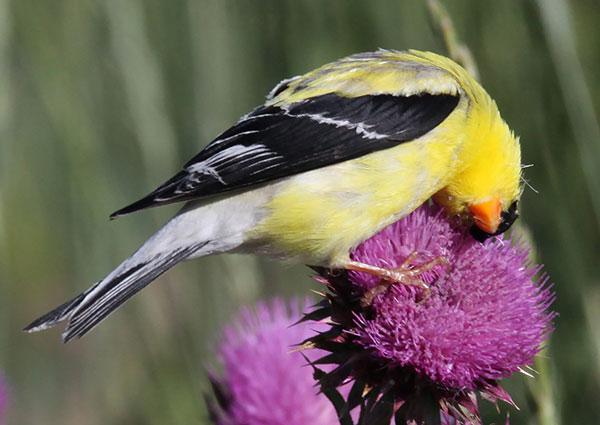

American Goldfinches (Spinus tristis), also known as wild canaries, are small, brightly colored birds native to North America.
They’re renowned for their vibrant yellow and black plumage, which is more intense in males during the breeding season.
These social birds have a unique diet, feeding primarily on seeds. With their charming appearance, sweet songs, and adaptability, they’re one of the most welcomed and common sights in backyards.
Breeding Male
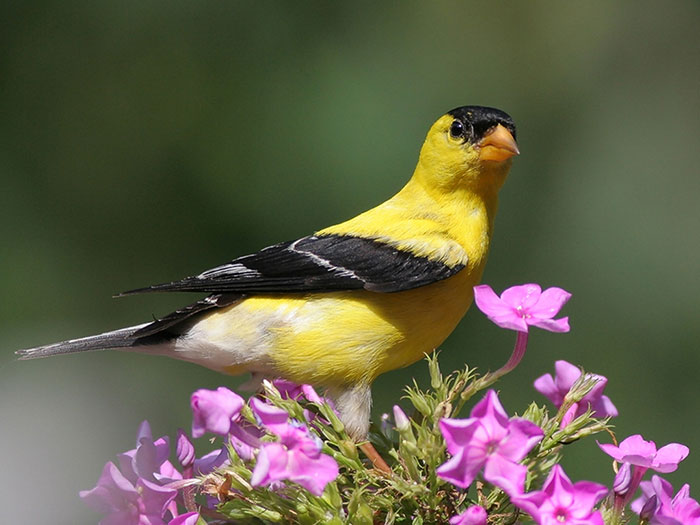
Male American Goldfinches’ appearance depends on whether it’s the breeding season or not. During the breeding season, the males have overall bright yellow plumage with contrasting black wings, a short and notched black-and-white tail, a black forehead, and delicate white markings on their wings.
After the breeding season has ended, the color of their plumage changes to beige, their head to yellowish beige, their cone-shaped bill from light orange to metallic dark gray, and their black wings get two big pale wingbars. They lose the black patch on their forehead.
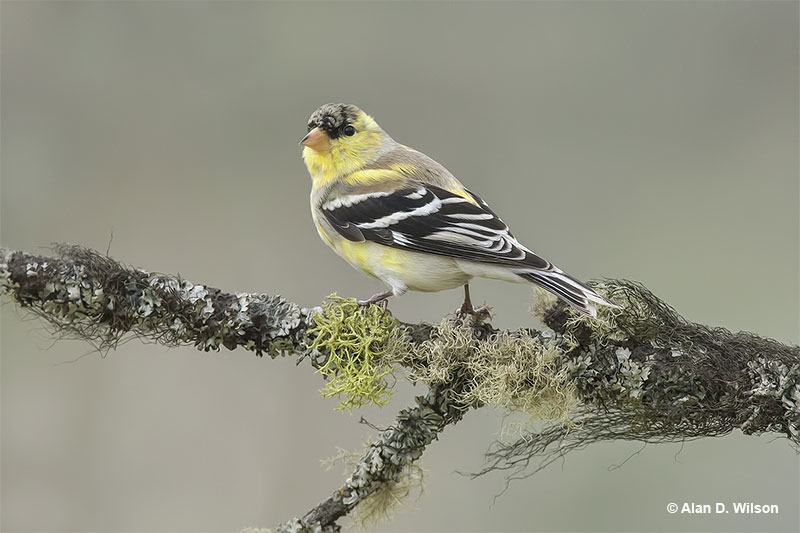
Molting males’ plumage is a mix of their breeding and non-breeding plumage. They are a patchwork of bright yellow, beige, black, and white. Their vent area is white year-round.
Female
Female American Goldfinches’ plumage also depends on the season. From afar, females may appear quite similar to males, albeit duller.
However, if you look a bit closer, you can see that their upperside appears dirtier and more olive-toned, their underside bright yellow, their forehead has a dark dirty patch instead of a solid black one, and their beak is orange.
© Alan D. Wilson
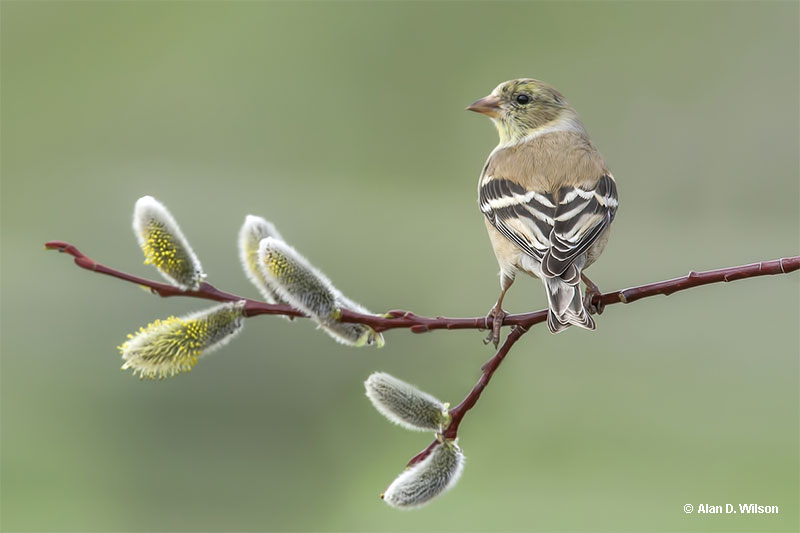
During the non-breeding season, they’re much more inconspicuous. Their upperside is pale brownish or beige, their underside pale yellowish, and their beak becomes duller and darker as well. Similarly to males, they have a whitish vent area and black wings with white wingbars year-round.
Juvenile
These finches can have 1-2 broods per year with 2-7, mostly 4-6 eggs in a clutch. American Goldfinch’s eggs are pale bluish to whitish with sparse light brown spotting. Only the female incubates the eggs, which takes about 12-14 days. They leave the nest after around 11-17 days but their parents care for and feed them for another 3 to 4 weeks.
Juvenile American Goldfinches appear similar to females. They are brownish or olive-toned above and pale yellow below. Their wings are black with two buff-colored wingbars.
This small finch grows to be 4.3-5.1 inches long and weighs between 0.4-0.7 ounces.
© Alan D. Wilson
Habitat
American Goldfinches prefer semi-open habitats that have bushes and trees for shelter and open weedy grounds for foraging. They are most commonly seen in weedy fields, patches of thistle, open floodplains, overgrown areas, open woods, roadsides, forest edges, and also in suburbs, backyards, and parks.
American Goldfinches nest in deciduous trees or shrubs less than 30 feet above the ground.
The female builds the cup of a nest in an upright or horizontal fork in the branches and constructs it of plant fibers and rootlets, weaves it together with spiderwebs, and lines it with plant down. When completed, it measures about 3 inches across and 2-4.5 inches high.
Diet
American Goldfinch’s diet consists of both plant and animal matter. These finches are mainly granivorous, which means that they mostly eat seeds.
Seeds from the plants of the composite family, such as thistle, sunflowers, and asters, are their particular favorites, although they also snack on small seeds from trees such as alder, elm, birch, and cedar.
They also eat grains, nuts, buds, bark from young twigs, maple sap, and snacks on the occasional insect during the summer.
American Goldfinches forage in flocks, usually in shrubs, trees, and weeds. You may also see them climbing on plants to reach the seeds. They also visit bird feeders, especially in the winter.
Behavior
American Goldfinches are active during the day. These fairly social birds can often be seen foraging in small groups. You may see them fluff their feathers or imitate the calls of other American Goldfinches.
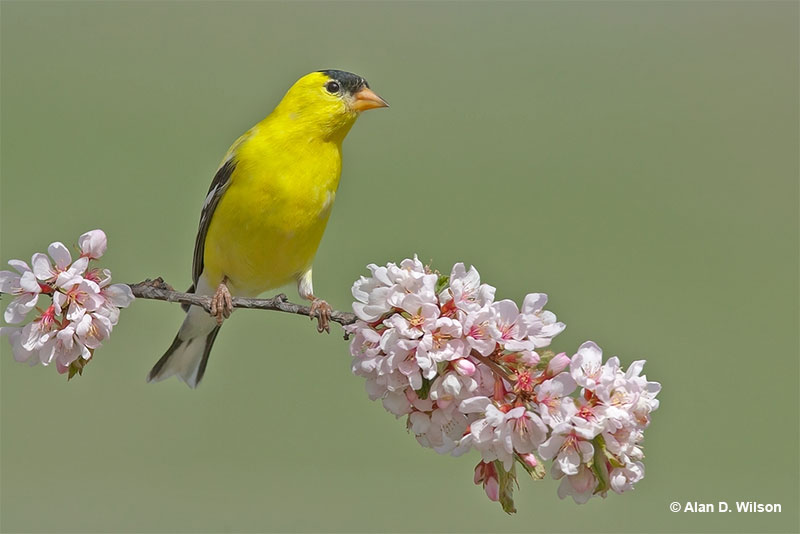
© Alan D. Wilson
These finches are mostly monogamous. Parenting duties are shared rather equally. While only the female incubates, then her partner feeds her.
After the chicks have hatched, the female starts leaving the nest more often to forage and chase away intruders. The latter includes calling at predators. Otherwise, they’re non-aggressive.
The male’s role in caring for the young gradually increases to the point where in the end, he may be the primary carer.
Range (and seasonal changes)
American Goldfinches range throughout most of North America and parts of northern and eastern Mexico. They’re year-round residents in the Pacific Northwest, Midwest, and eastern United States with their breeding range extending further north to Canada as far as Quebec, southwest Newfoundland, and Saskatchewan. During the winter, they migrate southward as far as Mexico.
American Goldfinch is widespread throughout its range and listed as a species of least concern on the IUCN Red List. They’re not threatened by human activity and their population remains stable.
Wing shape
American Goldfinch’s wingspan is just 7.5-8.7 inches long. Their wings are short, almost elliptical, which is perfect for bursts of fast and controlled flight. This also reflects in their distinct undulating flight pattern.
They beat their wings a few times, ascending, and then close them, descending a bit, and repeat the process.
Fun Facts
- Female American Goldfinches are excellent nest builders. Their nest is so solid and tightly woven that it can even hold water.
- American Goldfinches eat almost exclusively seeds, so when a cowbird lays its eggs in a goldfinch’s nest, then the alien nestling is almost certainly doomed since it needs more food.
- The oldest wild American Goldfinch lived to be 10 years and 5 months old. On average, they live for 3 to 6 years due to predation and males generally live longer than females. This is also why there are more male than female goldfinches.
- Goldfinches molt twice a year, once in the spring and once in late summer. Their second molt in late summer gives them an undercoat that helps to keep them warm during cold winter temperatures. They are even known to burrow underneath the snow to stay warm.
- With their bright and colorful plumage, American Goldfinches have earned themselves the nickname ‘wild canary’. This beautiful and vibrant bird is the state bird of three states: New Jersey, Washington, and Iowa.
Call
Only male American Goldfinches sing and their song is a series of sweet warbles and twitters that last for a few seconds. There seems to be no rhyme or reason for how they sing, and they learn new songs throughout their life.
American Goldfinches have 5 different calls: alarm, threat, contact, courtship, and feeding calls. Their most common call is given in flight and sounds like tsee-tsi-tsi-tsit. Some describe it as if the bird is singing po-ta-to-chip.
If you hear that a male and a female have an almost identical call, then they’re most likely a pair.
Similar Species
There are three species that are quite similar to the American Goldfich, but it is easy to distinguish them upon taking a closer look.
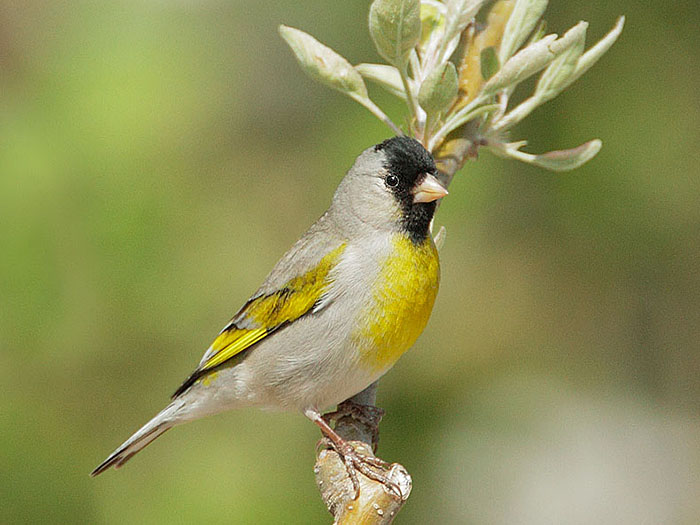
Lawrence’s Goldfinch
Lawrence’s Goldfinch
When it comes to Lawrence’s Goldfinches, they look more similar to female American Goldfinches.
Similarly to male American Goldfinches, they have a patch of black plumage on their faces, but their wings are more yellow in color than American Goldfinches’ black.
Overall, Lawrence’s Goldfinches are grayish in color and don’t have too much yellow on their plumages.
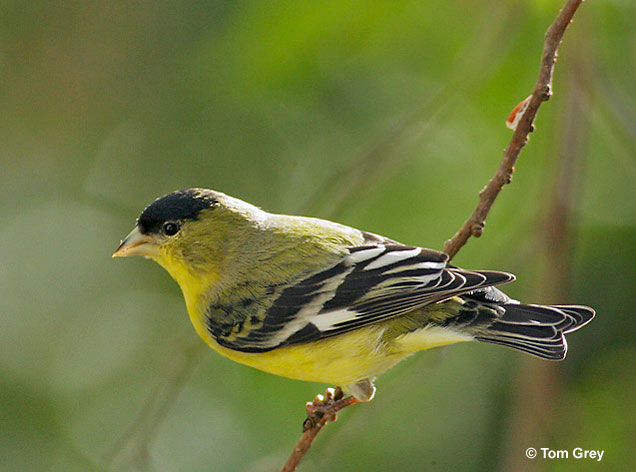
Lesser Goldfinch
Although Lesser Goldfinches look fairly similar to American Goldfinches, there are still a few key differences. Females look the most similar.
Overall, Lesser Goldfinches are quite a bit smaller than American Goldfinches, but the key differences come in plumage. American Goldfinches are primarily yellow, with some black on their wings, back, and tail.
Meanwhile, Lesser Goldfinches are more gray, and their plumage looks a bit duller compared to American Goldfinches.
Frequently Asked Questions
What is the difference between a Yellow Finch and a goldfinch?
You can differentiate between other yellow finches and an American Goldfinch by simply looking at their plumage. During the summer, American Goldfinches have bright yellow plumage with a black forehead and black wings with two white wingbars, and during the winter their plumage switches to brown and olive tones.
How rare is the American Goldfinch?
American Goldfinch is widespread and common throughout weedy semi-open areas of North America.
Where do American Goldfinches live?
American Goldfinches live in weedy fields, open woodlands, suburban areas, backyards, and other overgrown areas that have suitable shrubs or trees for nesting and plants to forage seeds from.
How can you tell an American Goldfinch apart from others?
During the summer, females are olive above and dull yellow below whereas male American Goldfinches are bright yellow and have contrasting black wings with white wingbars, and white patches around their tails. During the winter, both sexes are brownish with black wings and two pale wingbars.
