
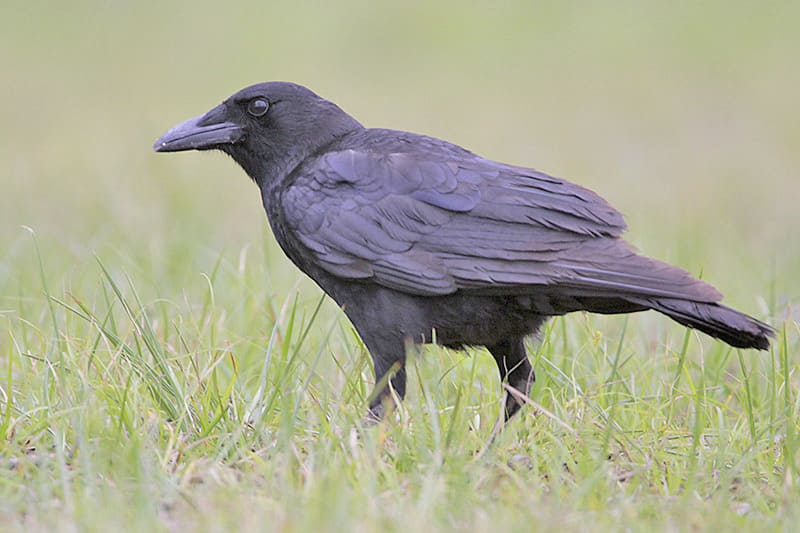

The American Crow (Corvus brachyrhynchos) is a well-known, completely black bird with long wings and a stout beak.
Did you know that American Crows can mimic human speech? These birds might be common but they are complex, highly intelligent and very interesting birds.
There’s always more to discover about the American Crow. Read on to learn more!
Identification
The American Crow is a good-sized, all-black bird with long broad wings, and a medium-length, rectangular tail. In certain light, we can also see purple and blue glossy highlights.
This tough bird has a strong, stout beak with a small, hooked tip, and fairly long, strong black legs and feet. Both sexes of the American Crow look the same although males tend to be slightly heavier.
On average, they are 17.5 inches long, have a wingspan of 35 inches, and weigh around one pound.
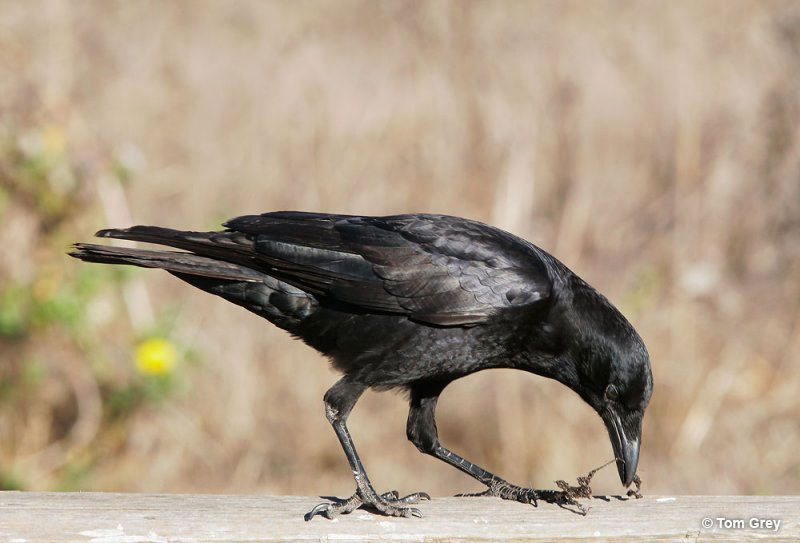
We often see these birds in flocks, especially during fall and winter. At those times of the year, American Crows can form groups of dozens or even a hundred birds! They forage together on the ground, perch on buildings, and in trees, and fly overhead in noisy groups.
In flight, American Crows rarely, if ever soar. Instead, they fly in a straight line with steady, deep flaps, often calling as they move from one spot to the next.
Most of us are used to the common cawing sound of the American Crow, but this species actually makes variations of that sound for different situations. For example, they make a long caw when meeting with each other, and a rattle like caw when diving at a predator.
Food
American Crows are omnivores that eat a wide variety of insects, small animals, nuts, seeds, grain, fruit, garbage, and carrion. These adaptable birds feed on a lot of grasshoppers and many other insects but avoid brightly colored bugs that probably taste bad.
They catch small fish and other aquatic creatures, mice, small snakes, crabs, and other small animals.
In addition, this species won’t hesitate to catch small birds, especially if a bird looks weak or can’t defend itself. They are also important predators of nesting birds, especially ducks and seabirds.
American Crows enjoy feeding on corn and other grain, and are regular visitors to landfills and other places with garbage.
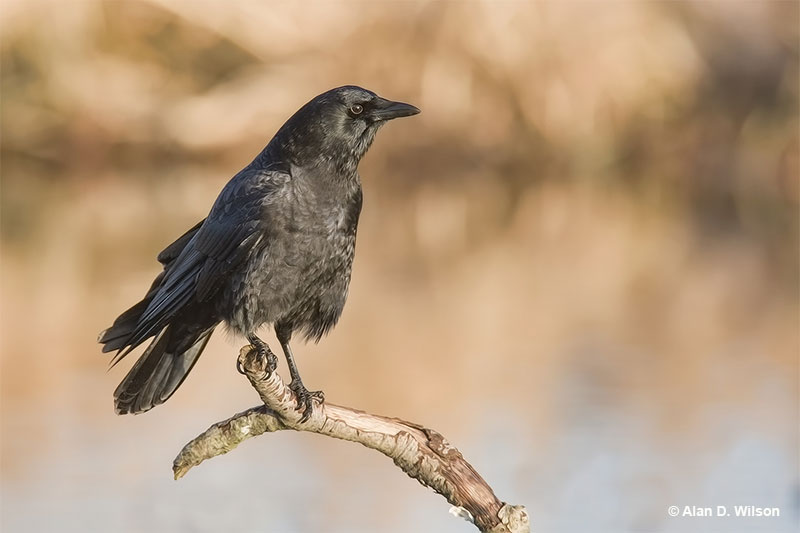
This species usually forages on the ground where it uses all sorts of techniques to find food. As crows walk along, they use their strong beaks to poke and dig into the ground and flip over objects. If they catch a snake, baby turtle, crab, or a nut, American Crows often fly high into the air and then break open the item by dropping it onto hard ground.
During the nesting season, American Crows frequently watch other birds, especially ducks, to see if they can find their nests and eat the eggs or nestlings.
Nesting and Eggs
Depending on where American Crows live, they can nest from February to late April. Crow pairs check potential sites together but the female has the final say on where to build the nest. She also does most of the nest building.
American Crows use sticks, bark strips, moss, and other plant matter to make a bulky cup nest lined with pine needles. They usually build their nest next to the trunk of a tree, sometimes, 60 feet high, but some crows build their nest on the ground.
Once the nest is ready, the female crow lays three to nine olive eggs with red-brown markings. They are 1.4 to 1.9 inches long and weigh 0.59 ounces each.
The mother crow makes food-begging calls for a few days before she lays her eggs and continues to make that same call as she incubates them for 17 to 21 days. During that time, her mate brings her food.
After the eggs hatch, the male and other “helper” crows bring food for the mother and the babies. Eventually, the female also forages for the nestlings, and they leave the nest 20 to 40 days after hatching.
The fledglings continue to be fed by their parents for more than a month after they leave the nest.
Current Situation
American Crows live in coastal areas of southern Alaska, in a large part of Canada, and in most of the lower 48 states. They avoid arid regions and dense forest but, in other places, live in open woodlands, parks, farms, wetlands, coastal habitats, and urban areas.
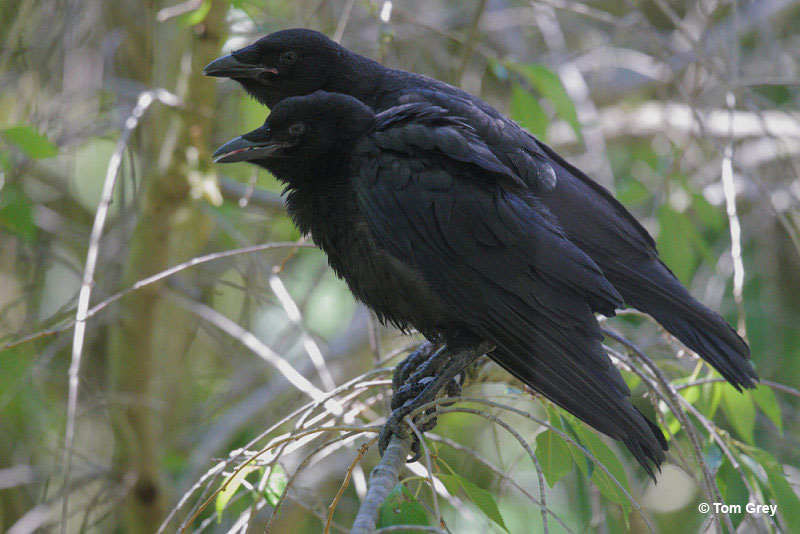
They are listed as Least Concern in the IUCN Red List and are a common bird throughout their range.
Wherever they live, American Crows are some of the most common and easily seen birds. They have actually benefited from the clearing of forests, landfills, and other human effects on the environment.
Related: How rare are albino crows?
These successful birds aren’t threatened in any way, and have an estimated population of 27 million. In the past, to protect their crops, farmers used dynamite to kill many roosting crows.
In present times, some farmers still shoot crows or use firecrackers and other methods to scare them. However, since we have learned that American Crows remove harmful insects and other pests, there is much less persecution than in the past.
Facts
- Young crows help their parents raise their younger siblings. For the first two to four years of their lives, instead of breeding and making their own nests, they bring food to the babies in their family.
- In the winter, American Crows can form huge roosts. In some places, there can even be 2 million birds roosting together! Such large numbers of noisy birds can cause nuisance problems especially when they are in urban zones.
- This species is very adaptable, especially when finding food. They can work together to distract otters and animals so they can steal their catch, steal food from other birds, sneak into backyards to feed on pet food, and do all sorts of other intelligent behaviors to find food.
- American Crows use tools in all sorts of ways. They have been seen breaking off bits of vegetation to drop onto people climbing to their nests, and forming small sticks to probe into holes.
- These birds even hold funerals! When a crow finds the dead body of another crow, it calls in other crows to gather together and make all sorts of loud noises. Researchers believe this helps them learn about potential threats but who knows? American Crows are pretty smart, maybe they are mourning together.
Similar Species
The American Crow is one of the easiest birds to watch and they are pretty easy to recognize. However, there are a few other, very similar bird species.
Fish Crow
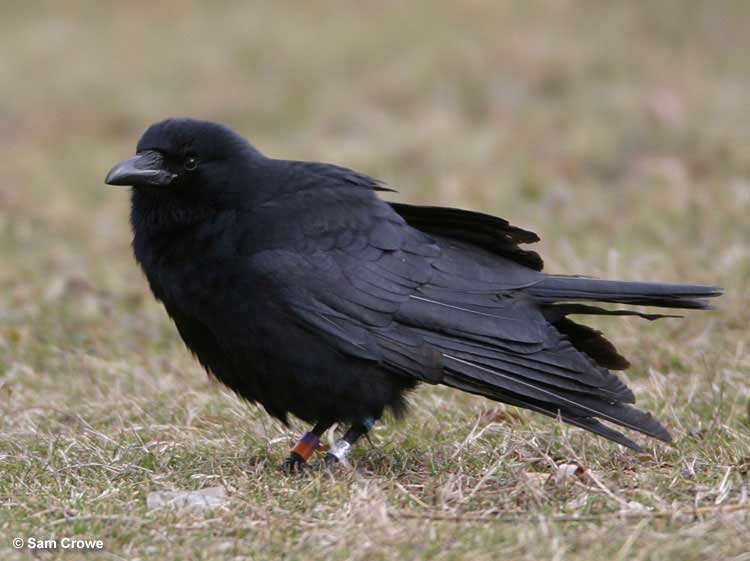
Fish Crows look just like American Crows. It has the same all-black plumage, long wings, and a stout beak.
It’s a bit smaller, but the only reliable way to separate these two species is by listening to their calls. The Fish Crow makes a distinctive and very different, brief, nasal sound.
They can also live in the same areas, but Fish Crows only occur in wetland habitats.
Chihuahan Raven
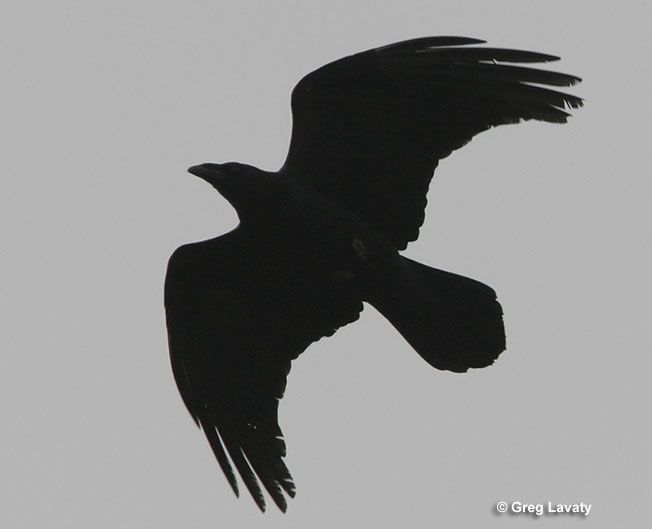
The Chihuahan Raven has black plumage like an American Crow and is similar but has slightly longer wings, and a wedge-shaped tail. It also has white on its neck, but this is usually hidden and hard to see.
With a close look, we can also see that it has a bigger beak with longer nasal tufts, and that it has shaggy feathers on its throat.
Related: Blackbird vs Crow vs Raven
This raven also soars on long, pointed wings, while crows do not soar and have less pointed wings. In addition, the Chihuahan Raven makes a rising, croaking call and lives in arid grasslands that crows usually avoid.
Common Raven
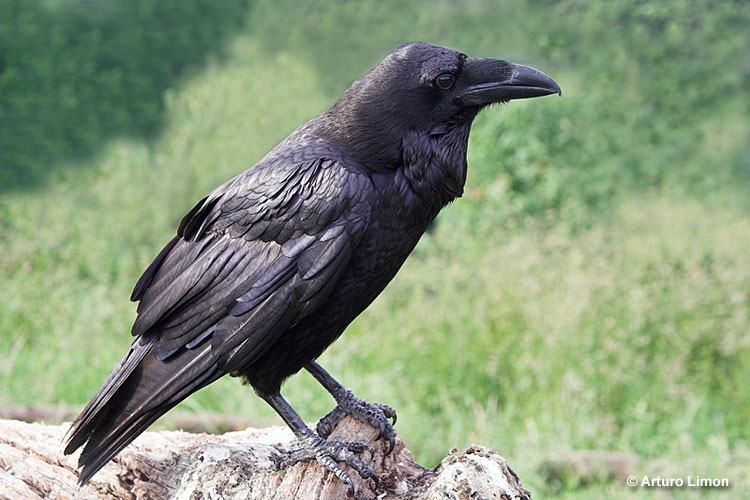
Like the other two similar species, the Common Raven also has black plumage. However, it is a much bigger bird, around two feet in length, frequently soars on long, pointed wings, and has a longer, wedge-shaped tail. This raven also has a bigger, heftier beak and makes loud croaking sounds.
Frequently Asked Questions
What is the difference between an American Crow and a raven?
The difference between an American Crow and a raven is that the crow is a smaller bird with broad wings, a rectangular tail, and a cawing vocalization. Ravens soar like hawks, have longer, more pointed wings, wedge-shaped tails, and make croaking calls.
What does the American Crow eat?
American Crow eats a wide variety of food. They feed on worms, insects, eggs and nestling birds, many other small animals, grain, and garbage.
How intelligent are crows?
Crows are very intelligent. Crows are some of the most intelligent birds on the planet, can mimic humans, and have large brains for their size.
What is the American Crow known for?
The American Crow is known for its intelligence, its loud “caw” calls, and being a very social bird that can form large flocks.
Do crows eat other birds?
Yes, crows eat other birds. They are important predators of baby ducks and other nestling birds, and also catch small birds that are exhausted or too weak to fly away.