

Blue has always been a color that captures the imagination, and in birds it feels almost magical.
From the soft sky-blue of a mountain bluebird to the deep, shimmering tones of a blue jay, these birds never fail to stand out.
- The Science Behind Blue Feathers
- #20 Bluethroat (Luscinia svecica)
- #19 California Scrub-Jay (Aphelocoma californica)
- #18 Black-throated Blue Warbler (Setophaga caerulescens)
- #17 Tree Swallow (Tachycineta bicolor)
- #16 Western Bluebird (Sialia mexicana)
- #15 Cerulean Warbler (Setophaga cerulea)
- #14 Blue Mockingbird (Melanotis caerulescens)
- #13 Blue Grosbeak (Passerina caerulea)
- #12 Blue-Gray Gnatcatcher (Polioptila caerulea)
- #11 Belted Kingfisher (Megaceryle alcyon)
- #10 Blue Rock Thrush (Monticola solitarius)
- #9 Florida Scrub-Jay (Aphelocoma coerulescens)
- #8 Little Blue Heron (Egretta caerulea)
- #7 Lazuli Bunting (Passerina amoena)
- #6 Eastern Bluebird (Sialia sialis)
- #5 Indigo Bunting (Passerina cyanea)
- #4 Steller’s Jay (Cyanocitta stelleri)
- #3 Blue Bunting (Cyanocompsa parrelina)
- #2 Mountain Bluebird (Sialia currucoides)
- #1 Blue Jay (Cyanocitta cristata)
- Questions & Answers of Blue Birds
Unlike most feather colors, their brilliant blues aren’t created by pigment but by the way light reflects off their feathers. In this guide, we’ll explore 20 types of blue birds you might encounter across North America.
The Science Behind Blue Feathers
When you see a bird that looks blue — like a Blue Jay, Indigo Bunting, or Mountain Bluebird — it’s easy to think their feathers contain blue pigment, the way a cardinal’s feathers contain red. But that’s not actually the case.
Birds don’t produce a true blue pigment. Instead, the color comes from the structure of the feathers. Tiny microscopic structures scatter light in a way that reflects only the blue wavelengths back to our eyes. This is called structural coloration, and it explains why so many types of blue birds seem to shine with such intensity.
It’s the same principle that makes the sky look blue: sunlight is scattered by particles in the atmosphere, and our eyes see mostly the blue part of the spectrum.
That’s also why a bluebird may look dazzling on a sunny day but seem duller or even grayish on a cloudy one. Without bright light to scatter, the blue disappears.
So, in short: blue in birds is an optical illusion of light and structure, not pigment.
In this list, we’ve included the most common blue birds and their descriptions.
#20 Bluethroat (Luscinia svecica)

Bluethroats are small birds with beautiful blue feathers on their throats and breast. The rest of their bodies are brownish gray with some extra orange on their chest and under their tails.
They are thought to be Old-World flycatchers and are closely related to Eurasian nightingales.
Bluethroats mainly live in Eurasia, however, they can be spotted in Alaska and northwestern Canada during the breeding season!
#19 California Scrub-Jay (Aphelocoma californica)
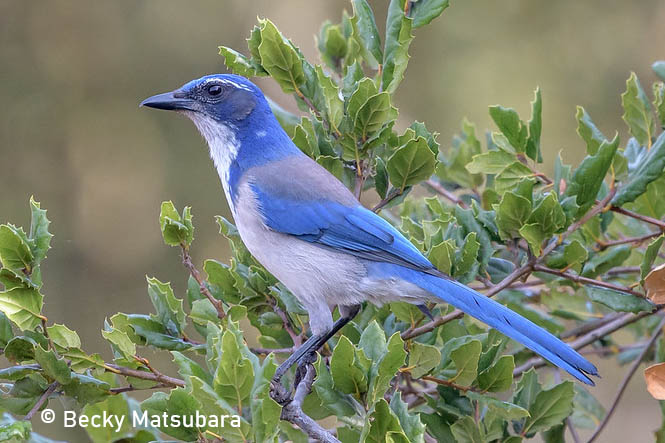
California Scrub-Jays were once considered to be the same species as Woodhouse’s Scrub-Jays, but since 2016, they have been considered to be different species.
California Scrub-Jays have beautiful blue plumage with a white throat and grayish-white underparts.
As their name hints, California Scrub-Jays are found in California, but their range extends to some parts of Oregon, Washington, and Mexico.
#18 Black-throated Blue Warbler (Setophaga caerulescens)
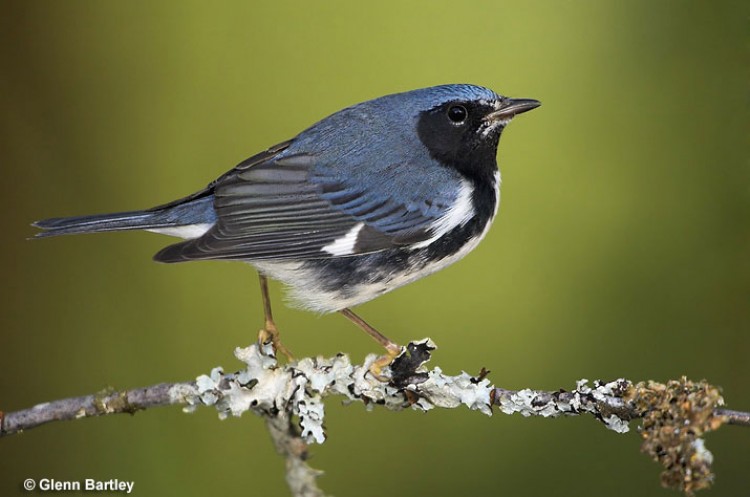
Black-throated Blue Warblers are nifty little birds with blue, black, and white plumage.
Females, however, are strikingly different – they have brown plumage.
These warblers are often found in forests and shrubs across the eastern side of the United States and Canada. They migrate to Central America.
#17 Tree Swallow (Tachycineta bicolor)
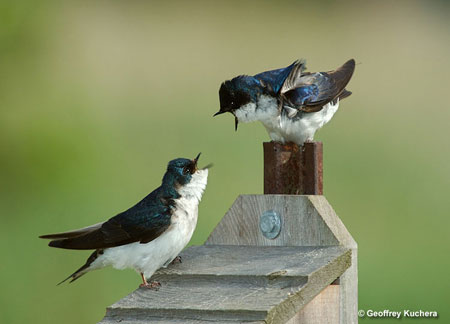
Tree Swallows get their name from the fact they like to nest in tree cavities.
They have a deep-blue iridescent head and back; their wings are black, and their underbelly white. Juveniles and immatures have a brownish-black back and a white underside.
These birds are competent aerialists, often seen chasing insects with high speed and precise maneuvers. It shouldn’t be too hard to find one, as they’re common across all of North America from spring to fall.
You can see them on open fields or marshes near bodies of fresh water, and also perching on utility wires, practicing their sweet high-pitched song consisting of chirps, whines, and warbles.
Related: Black and White Birds You Can See
#16 Western Bluebird (Sialia mexicana)
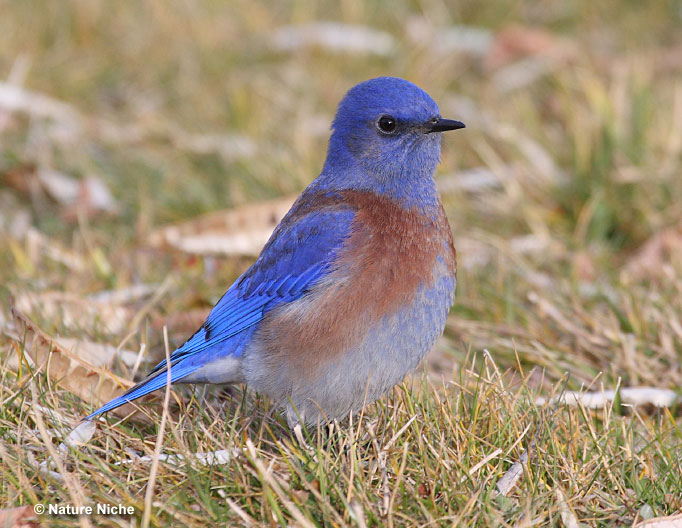
Western Bluebirds are part of the thrush family, and as their name hints, they are common in the western side of North America.
They are beautiful blue birds with some rusty orange on their chests and sides. Although they look similar to their eastern counterparts, Western Bluebirds are a tiny bit smaller or roughly the same size.
Western Bluebirds are very social. They can often be spotted around woodlands and in backyards.
#15 Cerulean Warbler (Setophaga cerulea)
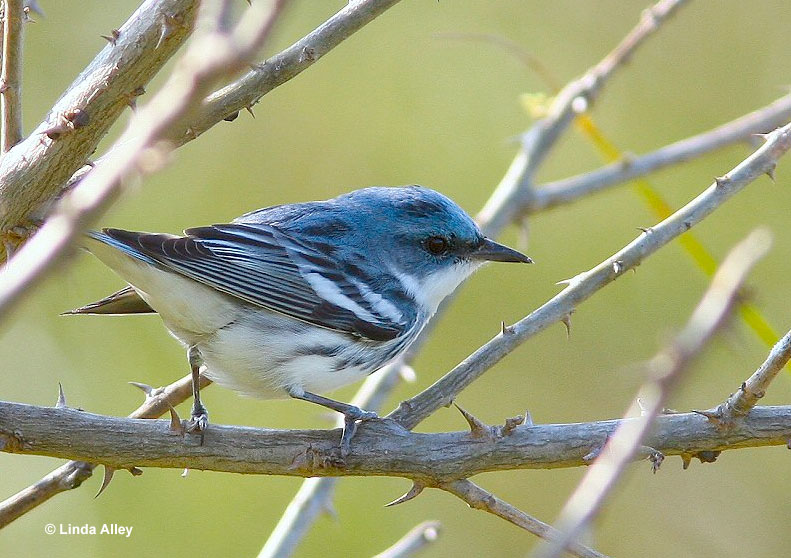
Male Cerulean Warblers are small blue birds with a cerulean head and back with thin black streaks, black and white wings, and a mostly white underbelly. Females have a greenish-blue or light green upper side and a pale-yellow underside. Juveniles usually look like females, although they may be a bit more yellow.
It is one of the smallest warblers, being only 4.3 inches long and having a wingspan of 7.9 inches.
They prefer to inhabit large unbroken areas of older forests with tall trees east of the Rocky Mountains, hopping along the branches of the canopy, and eating insects. It is listed as Near Threatened on the IUCN’s Red List because its population has been in a rapid decline due to the loss and degradation of habitat.
#14 Blue Mockingbird (Melanotis caerulescens)
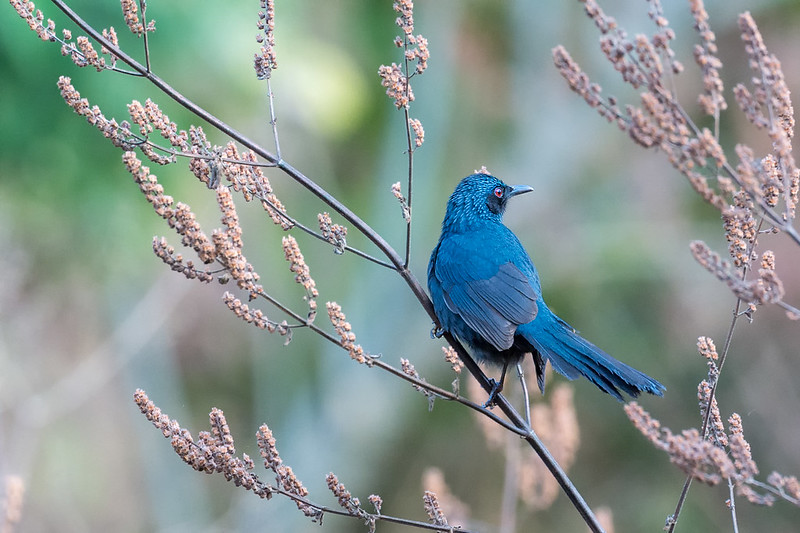
Blue Mockingbirds are medium-sized songbirds native to Central America but have sometimes been spotted in the southern United States. It has an overall slaty-blue plumage with a black mask on its face but can appear gray in the shade. It has reddish-brown eyes and a black bill and black legs.
You can find them in different woodlands from humid forests and thickets to scrub and pine-oak forests. The IUCN Red List has rated them as of least concern, but due to habitat fragmentation and loss, their numbers are dropping.
#13 Blue Grosbeak (Passerina caerulea)
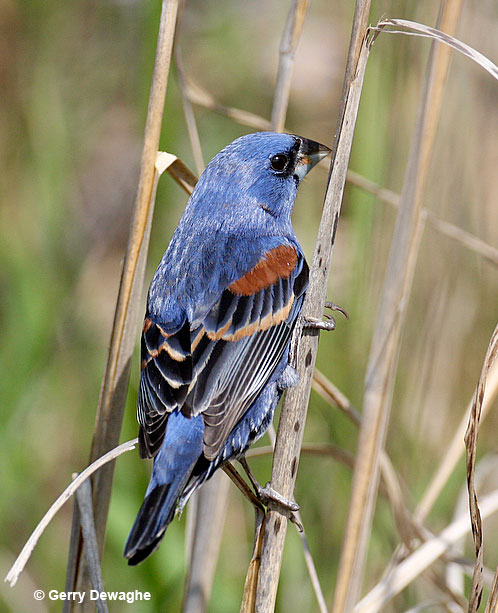
Blue Grosbeaks are migratory medium-sized birds common across the southern half of the United States. The male has an all-cobalt-blue plumage with a tiny black mask on its face, rust-colored tinges on its wing feathers, and a silver bill.
Females and immature males look like House Sparrows – their plumage consists of different shades of brown. A nonbreeding male is a patchwork of blue and cinnamon with rust-colored wingbars and a small black mask.
Since they mostly like to catch insects in higher foliage and perch on higher branches, then you can locate them by their short and sweet warbling songs in forest edges and old fields with brushy areas.
#12 Blue-Gray Gnatcatcher (Polioptila caerulea)
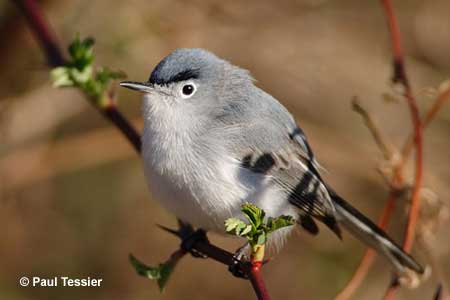
Blue-Gray Gnatcatcher
This tiny long-tailed ball of fluff is one of the more modest species among birds of blue color. Blue-Gray Gnatcatcher males have dusty blue upper parts and white underparts, a dark slender bill, and a black tail and wings. Females are mostly gray with blue hints, and juveniles appear greenish-gray.
All of them have a white ring around their eyes.
You can meet them in open woodlands and thickets, flitting about in the upper foliage, darting out to catch a tiny insect in mid-air. They also forage in trees and shrubs, picking insects from branches and beating larger beetles against a branch before eating them.
#11 Belted Kingfisher (Megaceryle alcyon)
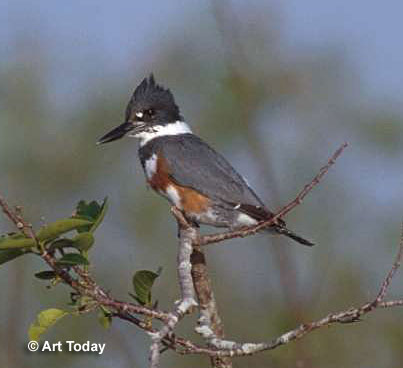
These energetic but solitary water kingfishers have dull slaty-blue plumage with a white collar around their neck and a white belly. The females also have a rust-colored band across their bellies and sides. All of them have black long and sharp bills, short legs and tails, and a large head.
Belted Kingfisher can be seen almost all across North America. They are freshwater birds, often seen perched on suitable watchpoints to detect prey and then diving into the water to catch it. Their diet includes fish, amphibians, insects, and small reptiles.
#10 Blue Rock Thrush (Monticola solitarius)
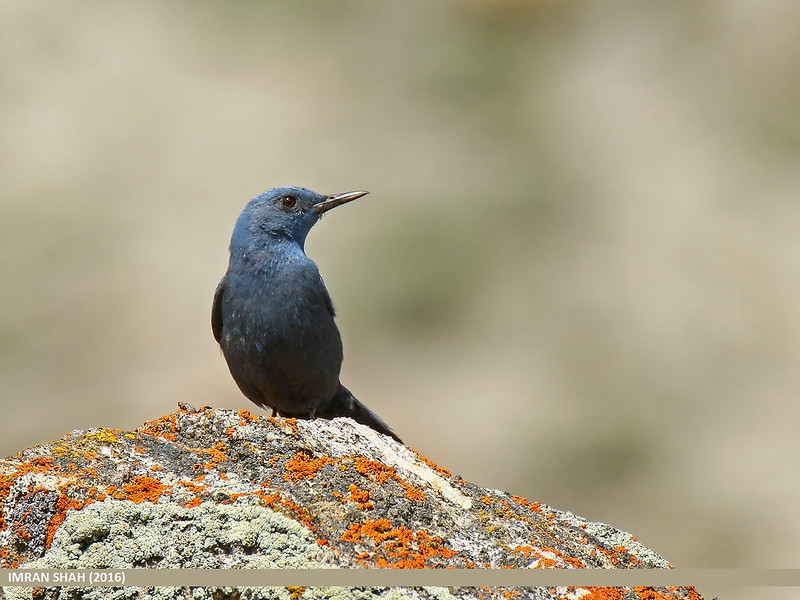
The male Blue Rock Thrush has a beautiful dark blue-gray plumage with dark, almost black wings and a long, dark tail, and a slender black bill. Females and immatures have dark brown upper parts and paler brown, scaly-looking underparts.
You can meet Blue Rock Thrushes in grasslands, mountainous areas, and shrublands in Eurasia, but it prefers rocky terrain or concrete buildings.
As the name suggests, it breeds and nests in open mountainous areas, especially rock cavities. You can see it hunting for various insects and small reptilians, but also feasting on berries and seeds.
#9 Florida Scrub-Jay (Aphelocoma coerulescens)
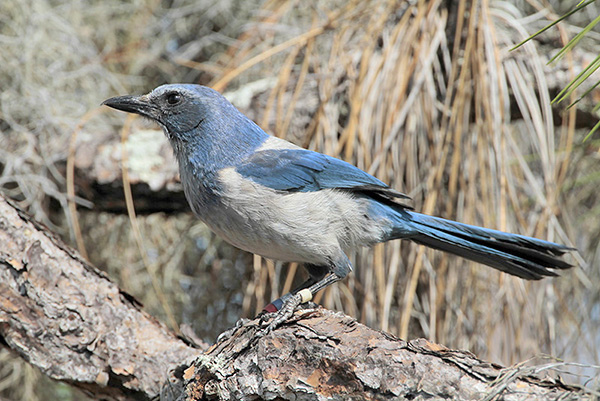
Photograph © Greg Lavaty.
The Florida Scrub-Jay is a beautiful blue and gray bird that is native to only Florida. Like other members of the Jay family, these birds are known for their long tails and intelligent minds.
These birds are named after their preferred habitat – Florida scrub.
Unfortunately, Florida Scrub-Jays are in a vulnerable state due to habitat loss. There are said to be around 2,500 to 9,999 adult birds, but the numbers are decreasing.
#8 Little Blue Heron (Egretta caerulea)
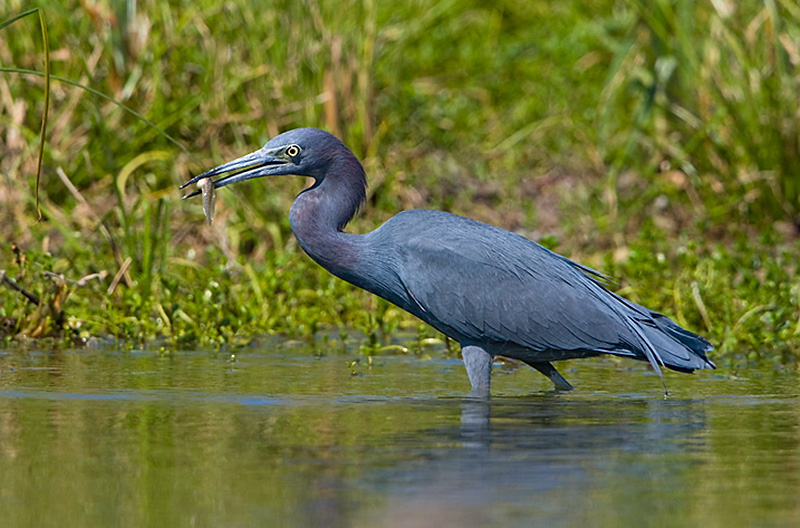
Copyright Glenn Bartley
Little Blue Herons are medium-sized waterbirds with long legs and a neck that can extend or retract like a telescope. Both the male and female little blue herons are dark grayish-blue with a grayish-purple neck and head.
The juveniles, however, are all white and the immature birds are a patchwork of blue and white, often referred to as “pied” or “calico”.
Related: What does seeing a blue bird mean?
These birds can be found east of the Rocky Mountains in various salt- and freshwater ecosystems.
They nest in colonies and you can happen upon one carefully wading or standing still in shallow water, peering to see what’s going on under the surface.
#7 Lazuli Bunting (Passerina amoena)
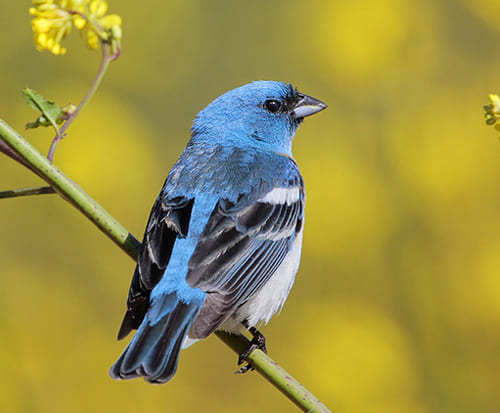
You can recognize a male of this species by its sky-blue head and back, thin black stripes from its eyes to its black cone-shaped beak, rust-colored chest, white belly, and blue-black-white wings.
Females and juveniles are very similar to House Sparrows, sporting warm browns on their plumage and barely visible blue tints on their wings. A non-breeding male looks similar to the male, only it has irregular cinnamon-colored patches in its plumage.
Lazuli Buntings are common west of the Rocky Mountains, and they can be found living in open woodlands, brushy areas, and along hedges and fields.
#6 Eastern Bluebird (Sialia sialis)
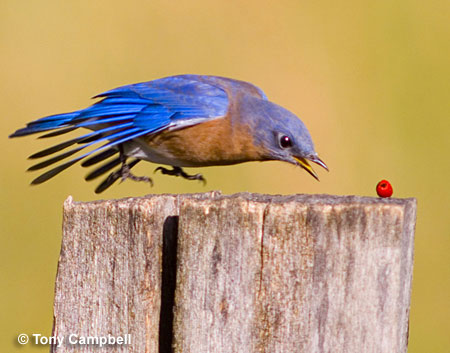
Eastern Bluebird is a small thrush with a thin black beak, black eyes and legs. The male Eastern Bluebird has royal blue upper plumage with black on the wings, a rust-colored chest, and a white belly. Females and immatures have a dull bluish-gray upperside with blue tinges on their wings and tail, reddish-brown chest, and white abdomen.
Juveniles are gray with white spots on their upper side, white with gray spots on their underside, with blue on their wings and tail.
They can be found east of the Rocky Mountains in open areas with little ground cover and scattered trees, foraging on the ground or making hovering flights to pick up their food. It is also the state bird of New York and Missouri.
#5 Indigo Bunting (Passerina cyanea)
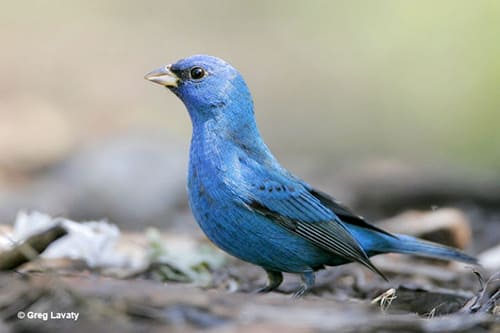
The male Indigo Bunting’s plumage is a deeper shade of blue with black on its wing feathers. Females and juveniles are different shades of brown with whitish tones on their undersides, being very similar to House Sparrows. Non-breeding males are a patchwork of blue and brown.
This small dark blue bird is a migratory species, ranging from southern Canada to northern South America, and uses stars to navigate at night.
You can often find it in open woodlands and grasslands, along roads and rivers, and in shrubs and trees, feasting on small seeds, berries, and insects and singing their high-pitched whistly songs atop high branches.
#4 Steller’s Jay (Cyanocitta stelleri)
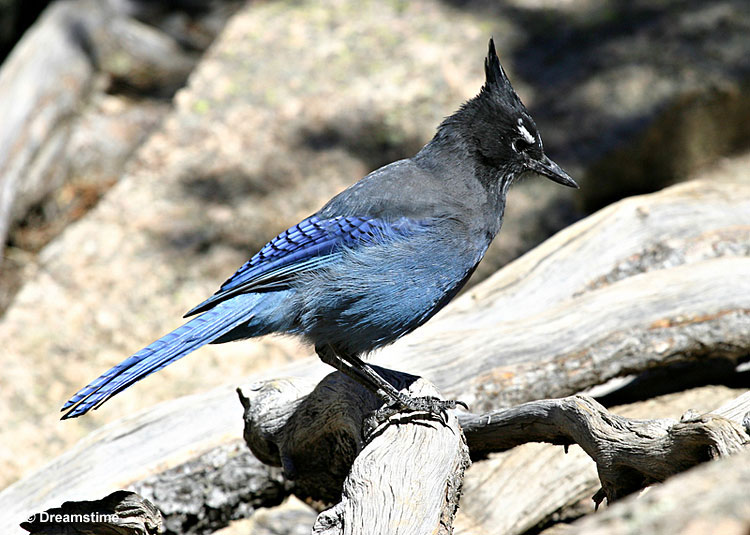
Steller’s Jay is a medium-sized bird native to dense coniferous forests along western North America and Mexico.
Both sexes have an ashy-blue body and dark blue to black head and neck. Juveniles look much like adults, only their crest is smaller and they are a paler shade of gray. Depending on the region, their plumage can have brighter and lighter shades or darker and duller shades of blue.
Steller’s Jays are very social and travel in groups, often mixing with other flocks of birds. These omnivores forage on the ground, moving around with confident hops, pausing often to survey their surroundings.
They have many calls, but most of them are harsh rapid screeches. Similar to Blue Jays, they mimic hawks to warn others and in an attempt to chase the hawk away.
#3 Blue Bunting (Cyanocompsa parrelina)
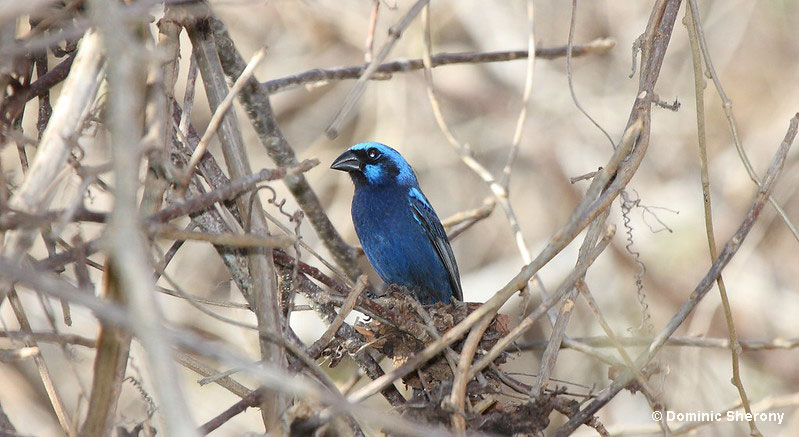
Male Blue Bunting’s plumage consists of various shades of blue. It appears to have blackish-blue upper parts and deep blue underparts with black on its wings and around its bill and eyes.
Females have a dull brownish plumage with a reddish tint to their belly. Immature males, however, are overall gray-blue with brown bellies.
Blue Buntings range along the east and west coast of Central America and have been observed in forests and brushy areas.
There isn’t too much information on their diet, but they are known to forage in lower vegetation.
#2 Mountain Bluebird (Sialia currucoides)
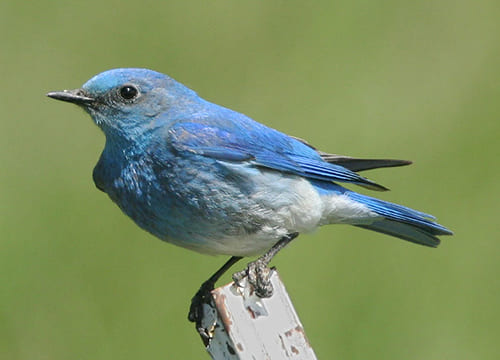
Male Mountain Bluebird’s body is azure blue all over with lighter shades on its underside. Females and juveniles only have some blue on their wings and tail but overall, they’re brownish-gray.
This bright blue bird can be seen all across western North America. They breed in the northern half, preferring open woodlands, and migrate back south during winter, preferring open areas at lower elevations such as meadows, and flat grasslands.
You can see them flit from perch to perch, looking for berries and seeds or hovering in the air before they drop to catch insects.
At dawn, you can hear loud, delightful chirruping. During the day, you can hear them softly warble or call with a tew or a high-pitched tink. These birds travel in small flocks and are a marvelous sight to behold!
#1 Blue Jay (Cyanocitta cristata)
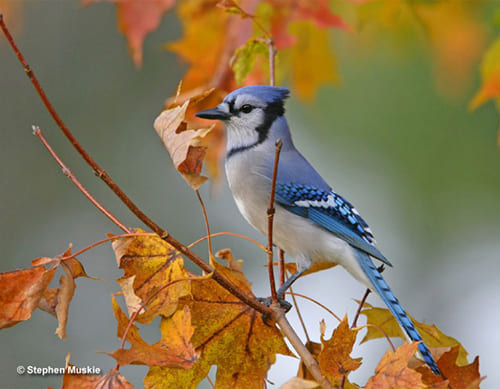
Blue Jays are loud and beautiful blue and white birds, common almost all across the United States. Both sexes have a sky-blue back and crest, white underside, and a black collar around their neck. Their wings and tail are mainly blue with black stripes across them.
Related: Identifying blue bird eggs
Juveniles are predominantly light brown or gray and white, with blue tinges on their wings and tail.
They can be found foraging on the ground in forests, urban, and suburban areas, and may sometimes mimic the calls of hawks to warn other Blue Jays of one or deceive other species that a hawk is nearby.
If you find an abandoned Blue Jay chick, best return it to the nest or move it to a shaded area, as parents will come back for it.
Questions & Answers of Blue Birds
What does it mean when you see a blue bird?
Seeing a blue bird is believed to mean good luck, as blue birds are a symbol of happiness, love, healing, and hope.
How rare are blue birds?
Blue birds are fairly common, although their numbers have been in a decline.
What kind of bird is blue?
The most common blue birds include the Mountain Bluebird, Blue Jay, Indigo Bunting, Blue Grosbeak, and some Thrushes, although technically, there is no such thing as a blue bird, only birds whose feathers reflect blue light, so it appears blue.

Donna
Monday 12th of June 2023
Do bluebirds in the southern part of the United States nest differently from the eastern part? I purchased a blue bird house and it has a small piece of wood under the hole, about a 1”. X 1.5 piece. I went to the bird store to buy a snake baffle and showed the owner the picture of my bird house. She said I don’t think you’ll get blue birds to nest in it. It’s from southern blue bird gardens , in Atlanta and it’s beautifully made. she said cause blue bird houses don’t have perches . It’s not really a perch per say, just a small piece of wood. Should I remove it? You would think if they are making blue bird houses they would know the proper design. The diameter of the hole is the correct size from what I have read . I live In Connecticut.
Patrick O'Donnell
Monday 19th of June 2023
@Donna- Since Eastern Bluebirds have the same nesting preferences in southern and northern states, it is kind of strange for that nesting box to have something like a perch.
Suggested nesting boxes for bluebirds don't have anything near the hole that a bird can perch on. Bluebirds don't need it and, most of all, the perch attracts House Sparrows and other small birds that want to use the box as a nesting site. If they find bluebirds in the nest box, sadly, they can kill the baby bluebirds.
With that in mind, it sounds like it would be best to remove that small piece of wood before installing your bluebird box.
Anne Richard
Thursday 8th of June 2023
I live in Cottonwood Az. We have a bird about the size of a Robin.Gray head and back all the way to the tail.Bright blue from the throat all of the underneath a bright blue.cant identify it.
Jeanne sellick
Tuesday 13th of June 2023
@Patrick O'Donnell, this bird is on tv it's small blue and he opens up over his face can't see his face at all And it is blue black and maybe another color
Patrick O'Donnell
Friday 9th of June 2023
@Anne- That sounds like an interesting bird. Without seeing the bird, it's hard to know what it is but two species that come to mind are Steller's Jay and Pinyon Jay.
Lea Ann G.
Monday 29th of May 2023
Hello, we live in Tennessee and we have an unusual tiny blue-green bird that commes to our hanging feeders every day. It looks tk be about the size of my thumb and is not even close to the color of hhr Indigo Buntings. This tiny bird is like the color of a Peacock's teal blueish green feathers. It seems to love the Nyger Seeds we put our like the finches do. It must have a mate because once or twice we have seen two of them on the feeders at the same time. Any help identifying is appreciated! Thanks, Lea Ann G.
Patrick O'Donnell
Wednesday 7th of June 2023
That sounds like a beautiful bird! Although it doesn't look like other Indigo Buntings, that's probably what this bird is. I know it looks pretty different but, in Tennessee, there just aren't that many other bird species that fit that description.
But why doesn't it look like other male Indigo Buntings? One interesting thing about male Indigo Buntings is that they can appear dark blue, teal blue-green, other shades of blue, and even entirely black.
This is because these birds don't actually have blue pigment. Instead, their blue colors are a product of the way light interacts with the structure of their feathers. In low, contrasting light, they look very dark. In some lighting, they have deep blue and in direct light, might look shining blue-green.
Elizabeth
Saturday 13th of May 2023
I live in a mixed forest with a creek and a medium sized pond at the bottom of a steep wooded hill. I saw a light clay colored bird with a very slight pinkish tint and a noticeable blue feather in its tail with some other clay-colored tail feathers. It was a 5-6" bird w no crest. Was it possibly a blue mockingbird? It did not seem to be as blue as even a female bluebird. The forest has plenty of brushy understory,open leafy areas fallen trees, tall trees, broken trees, saplings, with oaks,tulip poplars, maples, pines, ironwood.
Patrick O'Donnell
Thursday 8th of June 2023
@Elizabeth- Thank you for sharing your sighting of that interesting bird. I would guess that it is not a Blue Mockingbird because that species is bigger, is dark blue with a black mask, and is a Mexican species that is a very rare visitor to southern Texas. Without knowing where you live, it's hard to guess what your mystery bird might be. In which state do you reside?